
The usage of Social media networks has grown significantly over the last ten years.
The usage of social media networks has grown significantly over the last ten years. These platforms have become popular among all communities and age groups, as they have become a means of entertainment, communication and a way to maintain relationships with people across the globe.
However, as more people use these social apps, more private data is made publicly accessible. People tend to post personal pictures, information and professional achievements giving away information which could be misused by attackers online.
Social Media and Cybersecurity Threats
Social media networks have become targets for hackers due to the volume of user data they contain. In social media networks, phishing attempts, spyware, and even identity theft are frequent cybersecurity problems. Attackers tend to pose as verified profiles, or as influencers with a wide following. There is an important thing that these applications fail to notify the public and that is that profile verification and followers can both be bought with money and hence does not ensure legitimacy.
These platforms are also vulnerable to malware attacks. Attackers embed malicious links, images, documents, etc., into messages, emails and other postings. The users are then tricked into clicking on the link or downloading the malicious file, thus unintentionally allowing the malicious software onto one's device. This is then used by the attacker to steal user data or compromise the device. This is called data theft, which can lead to another attack called ransomware, where the attacker threatens to expose the information if they are not paid a significant amount of ransom.
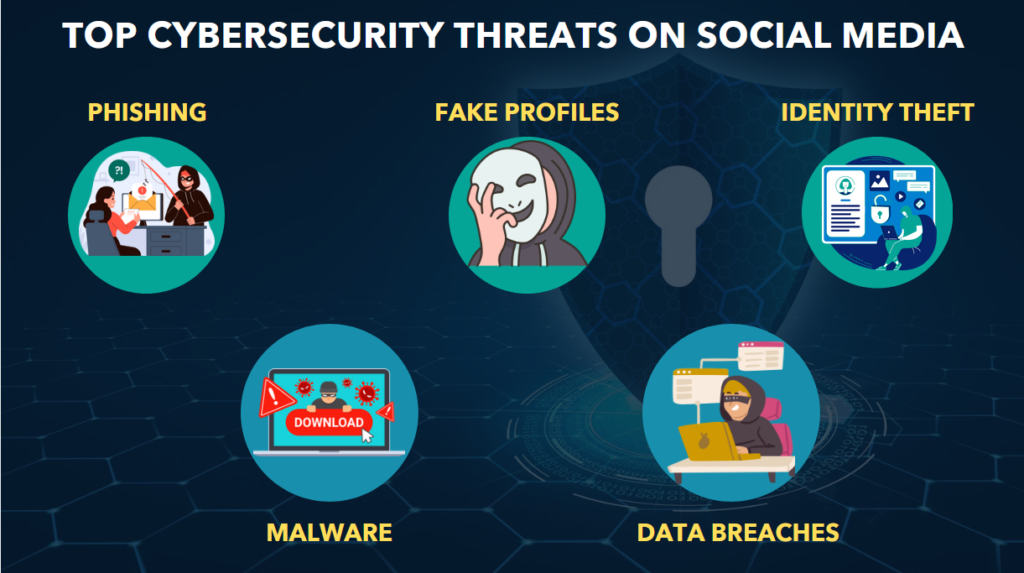 FIGURE 1 - CYBERSECURITY THREATS
 Risks of Identity Theft on Social Media
Another concern that has become very common is identify theft where hackers search user accounts that are public for personal information like birthdays, addresses and other private information. This is then used by the attacker to pose as certain individuals, to trick their friends or relatives into giving more information or money.
How Phishing Exploits Social Media Networks
Phishing is a frequent activity on social networks. Cybercriminals commonly send emails or messages posing as trustworthy businesses, authority institutions, or private individuals asking for login passwords or personal information. Because hackers use social engineering techniques to win users' confidence and then use that trust to convince users to divulge personal information, social media phishing attacks are incredibly successful and harmful.
Best Practices for Social Media Network Security
Users should follow safe cybersecurity habits to prevent falling prey to cyber attackers. Some of them are:
- Use Strong and Unique Passwords: This improves a user's security in case one account is compromised, the others still remain secure.
- Enable Two-Factor Authentication: Even though this brings an additional inconvenience of enabling a second layer of security, this helps to protect a user's account in case the password is compromised.
- Be Cautious of Unknown Links and Messages: Avoid clicking on suspicious links and other attachments that are part of the message or the email, especially from unknown senders.
- Limit Personal Information Shared Online: This is as basic as it gets; the less information hackers can access, the lower the chances of identity theft. Protecting such information by always having an eye from a security perspective helps prevent such data thefts.
Protecting User Privacy on Social Media Networks
In particular, users of social media should optimize the privacy settings for all the different types of platforms. When properly configured, this enables users to determine and limit who can see their posting information and other activity. Effective use of these settings can help users protect their personal information from unwanted exposure and reduce unauthorized access. The following strategies will help optimize your privacy on social media:
- Restrict Profile Visibility: Make profile settings "private" or "friends only" to keep personal information among trusted friends and family.
- Limit Information on Public Profiles: It is important to be careful about sharing sensitive information, such as one's birthday, home address, or phone number, on one's profile.
- Control Location Sharing: Disable location sharing for posts and other location-enabled applications unless necessary. Even Google accounts enabled on mobile devices store data about your movements. It is alarming to think that you can scroll back and see where you were on a specific day, five years ago, so just imagine an attacker gaining access to this information!
- Monitor Third-Party App Permissions: Many social media accounts are linked to third-party apps that may request access to your profile data. It is best practise to avoid such access, as the security policies of these applications will not be as strong as the social platforms and could even be malicious.
- Turn Off Facial Recognition and Targeted Ads: Limit ad targeting by adjusting "ad preferences" or "ad settings" to prevent data from being used for personalized ads.
Staying Proactive with Privacy on Social Media
By actively monitoring their privacy settings and limiting who has access to their information, users can significantly reduce the risk of identity theft and data misuse. Following these rules and careful usage of publishing information over the Internet could provide a better chance at a safer, more private experience. Generally, being proactive rather than reactive is advised, so it is very important to pay attention and take good initiative.
Want your digital assets to be protected?
CyberShelter provides innovative and modern cybersecurity products and niche services to individuals and organization against all kinds of cyber threats.
For the latest cyber threats and the latest hacking news please follow us on Facebook, Linkedin, and Twitter.
About the Author
Shariq Shajir is a Cybersecurity Engineer with a solid background in IT and computer application security. With two years of hands-on experience in IT support, he brings a practical understanding of tech infrastructure to his work in cybersecurity. As a certified (ISC)² Cybersecurity Professional, he is passionate about researching the latest in cybersecurity and sharing his findings to promote a culture of awareness. His work is driven by a commitment to advancing cybersecurity practices and helping others stay informed about the ever-evolving digital threat landscape.