

Attacks Escalate Using Critical RCE Flaw in Legacy D-Link DSL Routers
Exploit campaigns actively target unpatched router models to gain remote execution and spread malware
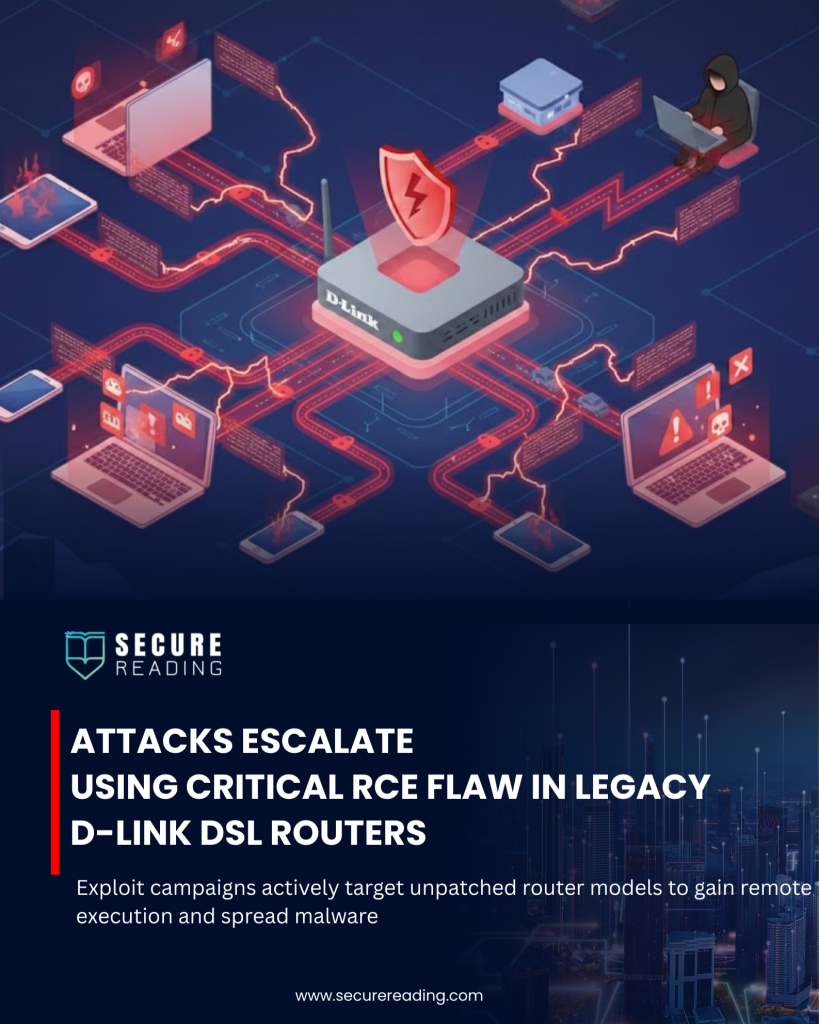
Security researchers report ongoing attack campaigns that exploit a critical remote code execution (RCE) vulnerability in legacy D-Link DSL routers. Adversaries actively scan for internet-facing devices that remain unpatched and vulnerable.
The flaw allows remote attackers to execute arbitrary system commands without authentication. Attackers use automated scanning tools to identify exposed D-Link routers. Once found, they send crafted requests that trigger the vulnerability and deliver malicious payloads.
Multiple exploit variants are circulating. In some cases, attackers attempt to install malware that repurposes the device into a botnet node. In others, the exploit injects scripts that open persistent backdoors, enabling ongoing remote control.
The affected models include older firmware versions that no longer receive security updates. Many of these devices still operate in home and business environments, making them attractive targets for widespread exploitation.
Attackers benefit from the simplicity of this flaw. They can compromise devices without valid credentials and maintain access silently. The compromise may also affect downstream networks if the router connects to internal systems.
Network defenders have observed spikes in suspicious traffic patterns originating from or targeting port 80 and port 8080 on residential and small office routers. These connection attempts frequently coincide with known exploit behavior for this specific D-Link vulnerability.
Impact
Remote exploitation of consumer networking equipment poses multiple risks:
- Botnet recruitment for DDoS or proxying
- Unauthorized remote access to network perimeter
- Traffic manipulation or interception
- Lateral movement toward internal assets
Because many legacy routers operate without visibility or monitoring, compromises can go unnoticed for extended periods.
Key Risk
Devices that no longer receive patches remain the easiest targets for attackers. Relying on outdated firmware exposes networks to both scanning and exploitation at scale.
Recommended Defensive Actions
- Immediately check firmware version on all D-Link DSL routers
- Apply available vendor patches or firmware upgrades
- Disable remote management if not required
- Restrict router admin access to trusted networks only
- Monitor traffic for unusual connections to common exploit ports
- Replace unsupported hardware where possible
Routine network inventory and segmentation help reduce the blast radius if a router becomes compromised.