

AWS Middle East Outage Exposes Cloud Resilience Gaps After Data Center Power Failure
A physical incident in an AWS Middle East region disrupted EC2, networking, and databases - reminding organizations why multi-zone architecture is critical.
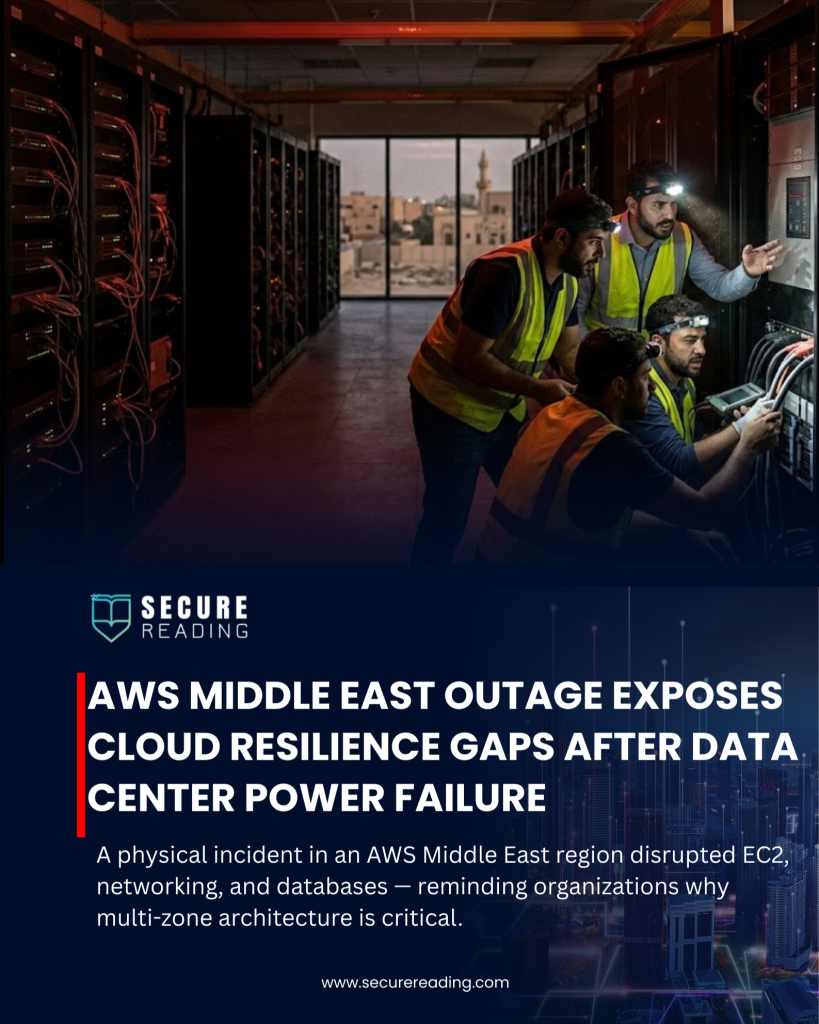
A major outage in the AWS Middle East (me-central-1) region on March 1, 2026, disrupted critical cloud services after a rare physical incident caused power failure inside a data center facility. External objects reportedly struck infrastructure near the site, triggering sparks and a fire. As a result, emergency responders ordered a complete shutdown of power, including backup generators, to ensure safety.
The disruption primarily affected a single Availability Zone (mec1-az2). However, the operational impact extended beyond the physical location because key cloud control plane services experienced degradation. Organizations relying heavily on that zone reported outages across compute, storage, and networking layers.
What Services Were Impacted
The power loss incapacitated multiple AWS services, including:
- Amazon EC2 instances
- Amazon Elastic Block Store (EBS) volumes
- Amazon Relational Database Service (RDS) databases
- Networking APIs and Elastic IP management
- Resource provisioning workflows
Meanwhile, customers attempting to reassign Elastic IP addresses encountered throttling errors and failures across several networking APIs. Critical operations such as AllocateAddress, AssociateAddress, and DescribeNetworkInterfaces experienced instability, which slowed recovery for many organizations.
Timeline and Recovery Efforts
AWS began investigating connectivity issues early in the morning and confirmed a localized power failure shortly afterward. Engineers quickly implemented traffic weighting strategies to redirect workloads away from the damaged facility toward healthy Availability Zones.
Throughout the day, AWS deployed configuration adjustments to stabilize API functionality. Gradually, networking operations recovered, and engineers released an important mitigation that allowed customers to forcefully disassociate Elastic IP addresses from affected resources. This change enabled organizations to relaunch services in unaffected zones while retaining their original IP addresses.
However, physical infrastructure restoration remained dependent on clearance from local authorities. Therefore, AWS advised customers to operate from alternate Availability Zones or even different regions until full recovery could occur.
Why This Incident Matters for Cyber Resilience
Although the outage resulted from a physical event rather than a cyberattack, the incident carries significant cybersecurity and business continuity implications.
First, it demonstrates that cloud availability risks are not limited to cyber threats. Physical hazards, infrastructure damage, and environmental factors can produce equally severe downtime.
Second, the event reinforces the importance of architectural resilience. Organizations that deployed workloads across multiple Availability Zones experienced minimal disruption. In contrast, single-zone deployments faced service outages, delayed recovery, and operational impact.
Third, dependency on networking control plane functions can become a hidden risk. Even when compute resources exist elsewhere, API failures can slow restoration if automation workflows depend on them.
Strategic Lessons for UAE and GCC Organizations
For enterprises across the Middle East — especially in sectors like finance, government, aviation, healthcare, and energy — this outage provides critical lessons:
- Design workloads across multiple Availability Zones by default
- Maintain cross-region disaster recovery strategies for critical systems
- Regularly test failover and restoration procedures
- Avoid single points of failure in networking dependencies
- Ensure backup and snapshot automation works independently of primary zones
Additionally, leadership teams should treat cloud resilience as a business risk discussion, not merely an IT configuration issue. Operational downtime directly affects revenue, customer trust, and regulatory exposure.
The Bigger Picture
Cloud providers offer powerful reliability frameworks. However, responsibility for resilience remains shared. Organizations must architect for failure scenarios — including unlikely physical incidents — to maintain operational continuity.
Events like this remind decision-makers that resilience is not about preventing outages entirely; it is about surviving them without business disruption.