

How Business Email Compromise (BEC) Scams Steal Millions
BEC attacks don’t use malware. They use trust — and that’s why they work.
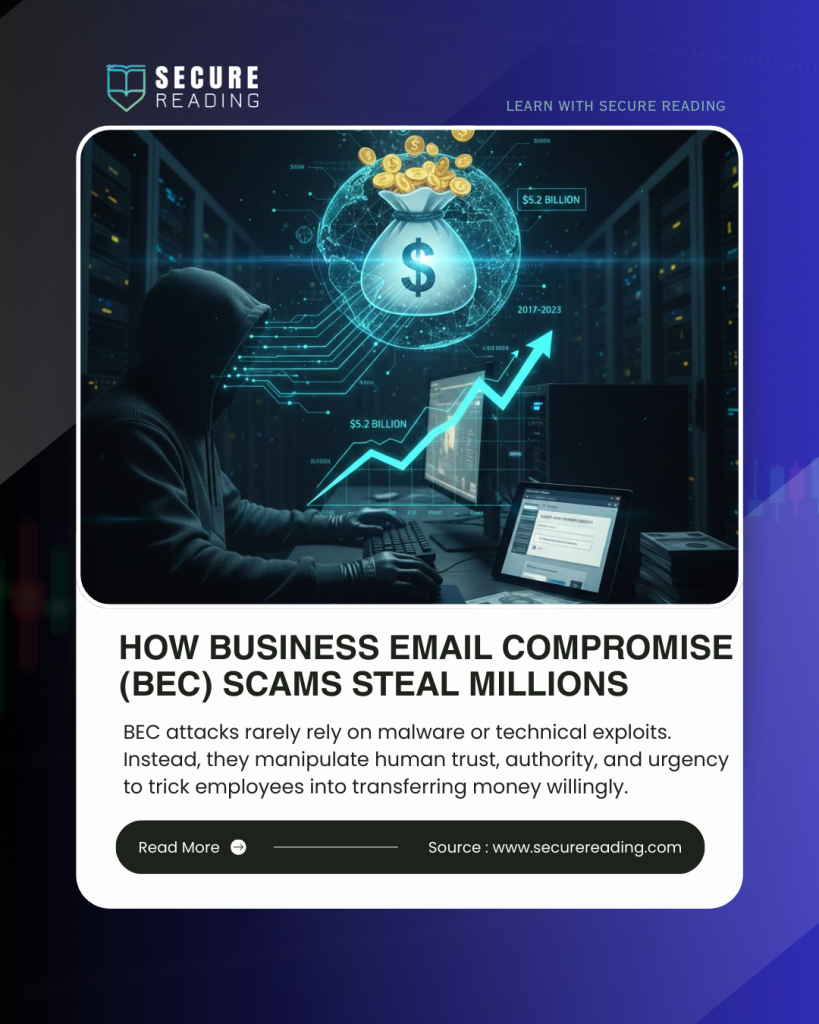
A Single Email. A Fake Executive. A Million-Dollar Transfer.
Business Email Compromise (BEC) scams are among the most financially damaging cybercrimes today.
Unlike ransomware, BEC attacks do not encrypt systems. Instead, attackers manipulate employees into transferring money to fraudulent accounts.
As a result, companies often lose funds instantly — with little chance of recovery.
What Is a BEC Scam?
A Business Email Compromise attack occurs when a cybercriminal impersonates a trusted party to trick an organization into sending money or sensitive data.
Attackers typically impersonate:
- CEOs or CFOs
- Vendors or suppliers
- Legal advisors
- HR executives
Because the message appears legitimate, employees may comply without verification.
How a BEC Attack Actually Happens
Step 1: Reconnaissance
Attackers research the company.
They study:
- LinkedIn profiles
- Company websites
- Press releases
- Organizational hierarchy
They identify finance staff and senior decision-makers.
Step 2: Email Spoofing or Account Compromise
Attackers either:
- Spoof an executive’s email address
- Register a lookalike domain
- Or compromise a real email account through phishing
In many cases, they monitor conversations quietly before striking.
Step 3: Creating Urgency
The attacker sends an urgent request, such as:
- “Process this confidential wire transfer immediately.”
- “We are closing a deal. Send payment before 5 PM.”
- “Vendor bank details have changed. Update records now.”
Urgency reduces critical thinking.
Therefore, employees act quickly.
Step 4: The Money Moves
Once the transfer is approved, funds move to mule accounts. From there, criminals withdraw or launder the money through layered transactions.
By the time fraud is discovered, recovery becomes extremely difficult.
Why BEC Is So Effective
BEC attacks succeed because they exploit:
- Authority bias
- Trust in internal communication
- Pressure to act quickly
- Lack of verification procedures
Unlike malware, BEC leaves no obvious technical footprint.
The email looks normal. The transaction appears authorized.
That makes detection harder.
Real Financial Impact
Globally, BEC scams cause billions in annual losses.
Organizations across industries have lost:
- Six-figure vendor payments
- Multi-million-dollar acquisition funds
- Payroll deposits redirected to attackers
Meanwhile, reputational damage often follows.
Common BEC Variations
- CEO Fraud – Fake executive requests urgent transfer
- Vendor Fraud – Fake invoice with changed bank details
- Payroll Diversion – Employee salary redirected
- Lawyer Impersonation – Fake legal urgency in acquisitions
- Account Takeover – Real email used for fraudulent requests
Each version targets financial trust mechanisms.
Why Traditional Security Tools Fail
Firewalls and antivirus software cannot detect well-written emails.
Even email filters may miss carefully crafted domain lookalikes.
Therefore, BEC defense depends more on process than technology.
How Organizations Can Prevent BEC
Strong defenses include:
- Mandatory verbal verification for payment changes
- Dual approval for large transactions
- Domain monitoring for lookalike registrations
- Multi-factor authentication for email accounts
- Regular phishing simulations
- Clear financial authorization policies
Most importantly, employees must feel empowered to question unusual requests — even from executives.
Final Thought
BEC scams do not rely on hacking software vulnerabilities.
They exploit human trust and organizational processes.
That is why even mature companies fall victim.
Cybersecurity is not only about stopping malware.
It is about protecting decision-making processes from manipulation.