

The Silent Cyber Risk Behind Rapid Business Expansion in the Gulf During Regional Tensions
As geopolitical tensions and conflicts in the Middle East reshape the risk landscape, organizations expanding across the Gulf face increasing exposure through connected systems, digital supply chains, and cloud infrastructure.
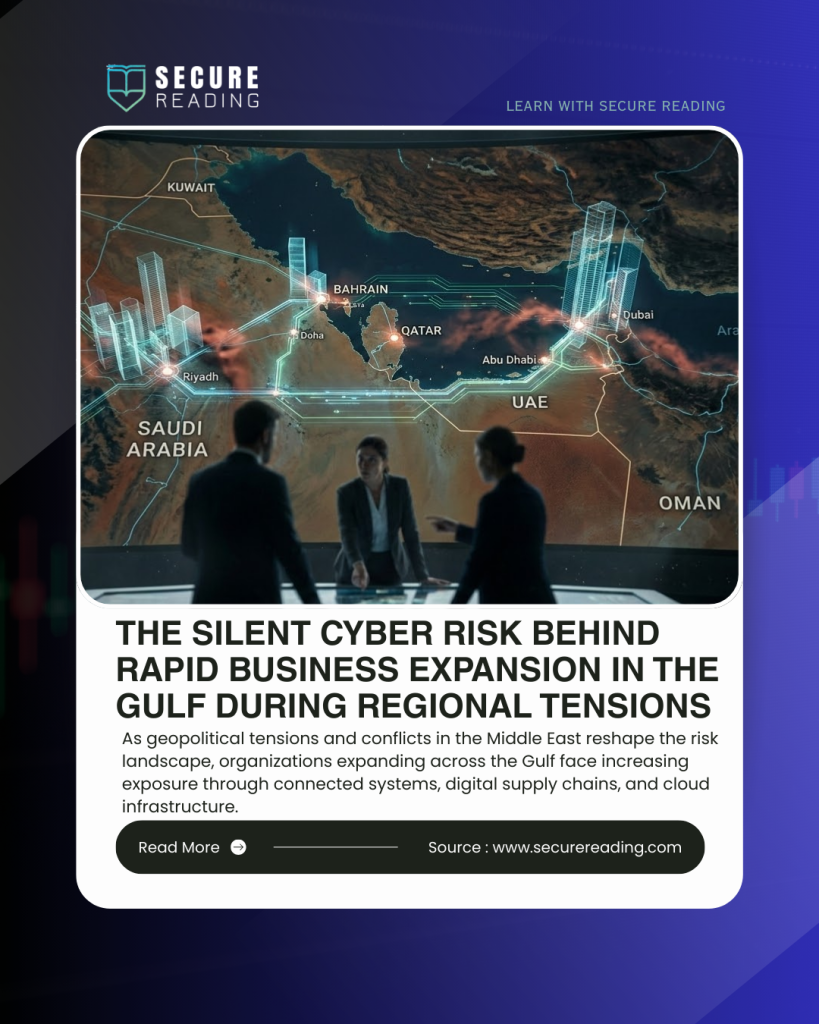
The Gulf region has become one of the fastest-growing business and technology hubs in the world. Companies across sectors—from finance and logistics to aviation and energy—are rapidly expanding operations across the Middle East.
However, while businesses focus on growth, partnerships, and market expansion, a less visible risk is quietly emerging in the background.
As geopolitical tensions continue to evolve in the region, the digital infrastructure supporting modern organizations is becoming an increasingly attractive target.
Growth Brings New Digital Exposure
Modern business expansion is deeply connected to technology. Companies rely on cloud platforms, interconnected supply chains, remote collaboration tools, and globally distributed data systems.
While these technologies enable rapid scaling, they also expand the digital footprint of organizations.
This means that when a company grows across multiple countries, its digital environment grows as well—often faster than its ability to fully monitor or secure it.
In regions experiencing geopolitical tension, this expanding digital footprint can introduce new operational risks that many organizations may not immediately recognize.
Regional Conflicts Now Extend Into Cyberspace
Historically, conflicts were primarily physical. Today, the situation is different.
Cyber operations have become a parallel dimension of geopolitical competition.
Critical industries—such as energy, telecommunications, aviation, and financial services—have increasingly become targets of cyber espionage, disruption attempts, and intelligence gathering.
Because many Gulf-based organizations operate global digital infrastructure, their networks may intersect with regions and systems involved in geopolitical tensions.
This creates indirect exposure that businesses may not anticipate.
Supply Chains Are More Connected Than Ever
Another factor increasing risk is the modern digital supply chain.
Businesses rarely operate alone. Instead, they rely on dozens—or sometimes hundreds—of technology partners, vendors, and service providers.
Cloud platforms, SaaS tools, third-party vendors, and external IT integrations are now essential components of daily business operations.
However, each external connection introduces potential pathways through which digital disruptions could spread.
A vulnerability affecting one organization in a supply chain can quickly impact others that rely on its services.
Critical Infrastructure Is Closely Interconnected
The Gulf region is known for its advanced infrastructure and smart-city initiatives.
Many sectors—including transportation, energy distribution, logistics networks, and financial services—operate highly digitized environments.
These systems depend on continuous connectivity between operational technology, cloud services, and enterprise networks.
While this interconnectedness enables efficiency and innovation, it also means that disruptions affecting digital systems can ripple across industries more quickly than ever before.
Business Resilience Is Becoming a Strategic Priority
In an environment shaped by global uncertainty and technological dependence, business resilience is becoming an essential leadership consideration.
Organizations are increasingly evaluating how prepared they are to respond to unexpected digital disruptions that may originate beyond their immediate environment.
This includes reviewing how connected systems, supply chains, and cloud services interact with their operations.
Companies that understand their digital exposure are often better positioned to maintain continuity and stability when external events affect the technology landscape.
Looking Ahead
The Gulf region will likely continue to attract global investment, innovation, and technological growth.
However, as business ecosystems expand, the digital environments supporting them will also grow more complex.
In a world where geopolitical developments and digital infrastructure are increasingly interconnected, organizations are recognizing the importance of understanding the broader technology risks surrounding their operations.
The companies that succeed in this evolving environment will be those that combine growth with awareness of the digital landscape that supports it.