

Cybersecurity Risk Appetite
A Comprehensive Framework for the CISO and the Information Security Function
Enterprise risk appetite is set by the board. Cybersecurity risk appetite is what the CISO does with it. The translation between the two — and its onward connection to the assessments, the treatment decisions, the controls, the vendor regime, and the response playbooks that the security team actually runs — is where most cyber programmes either come alive or quietly fail.
1. Why Risk Appetite Is the CISO's Most Underused Tool
Most CISOs spend their careers making risk decisions. Which controls to deploy, which findings to close, which vendors to onboard, which incidents to escalate, which patches to expedite, which exceptions to grant — every working day produces dozens of these calls. The quality of those decisions defines the security posture of the organization. And yet, in most organizations, those decisions are made without an explicit framework that says what the organization considers an acceptable level of risk.
In the absence of an explicit framework, decisions get made anyway. They get made on personal judgement — the CISO's, the analyst's, the engineer's, the vendor's. They get made on convention — what we did last time, what feels right, what is least likely to attract criticism. They get made on availability bias — the threat that was in the news, the incident that just happened to a peer organization, the audit finding that is still open. The decisions are usually defensible in isolation, but they are not coherent in aggregate. They do not add up to a posture. They add up to a programme that is consistent only in its inconsistency.
A cyber risk appetite framework changes this. It does not eliminate judgement — judgement is still required at every step — but it gives that judgement a reference point. It tells the security team that this organization, having considered the matter, has decided to accept this much exposure in this category, no more and no less. Every subsequent decision becomes a comparison: is this risk inside our stated appetite or outside it. The question is not whether the answer is always easy. The question is whether the same question gets asked, by every decision-maker, every time.
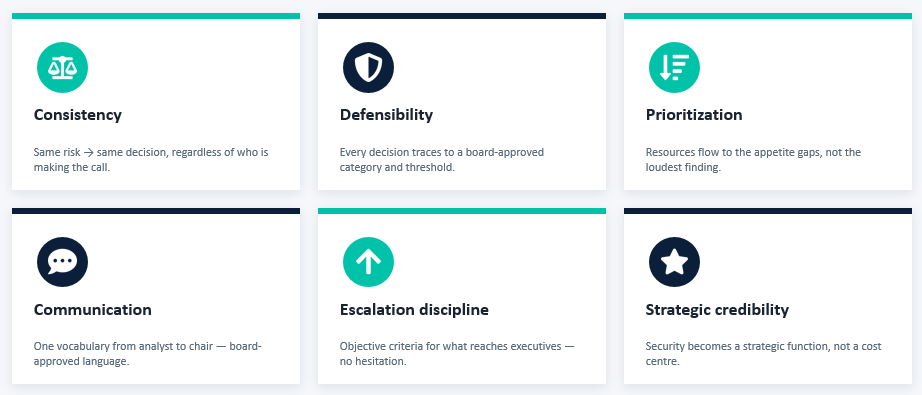
The case for an explicit appetite framework rests on six practical benefits, each of which matters more in a mature organization than in a young one:
- Consistency. The same risk produces the same decision regardless of who is making it. Different analysts triage findings the same way. Different engineers apply the same patch SLAs. Different business units propose investment cases that can be compared on a common basis. The security programme becomes coherent rather than a collection of independent judgements.
- Defensibility. Every major decision is traceable to a board-approved appetite category and a documented threshold. When a regulator asks why a particular risk was accepted, the answer is not a personal opinion. When the audit committee questions a control choice, the rationale has an audit trail. When an incident occurs, the prior decisions about residual risk are explainable rather than embarrassing.
- Prioritization. Limited resources are directed at the gaps that matter — the categories where current exposure exceeds appetite — rather than at the loudest finding or the most fashionable threat. The roadmap becomes an instrument of risk reduction rather than a checklist of unrelated initiatives.
- Communication. The same vocabulary runs from the analyst preparing the risk register to the chair reviewing the dashboard. The security function speaks to the business in terms the business has already approved. Conversations about risk become productive rather than fraught.
- Escalation discipline. Some risks are too large for the security function to absorb alone. An appetite framework makes the escalation criteria objective. When a residual risk sits outside appetite, executive sign-off is required; it is not a matter of how senior the analyst feels, or whether the CISO is comfortable carrying it. The right things reach the right people at the right time.
- Strategic credibility. A CISO who can articulate appetite, demonstrate alignment with enterprise risk management, and show how every major initiative serves the framework occupies a fundamentally different position with the board than one who reports on technical incidents and budget requests. Appetite is the language that converts security from a technical function into a strategic one.
None of these benefits is theoretical. They show up in board minutes, in audit reports, in incident reviews, in budget defences, and in how seriously the security function is taken when it matters. The cost of building the framework is real but bounded — typically two to four quarters of focused effort. The cost of operating without it is unbounded, because it shows up only when something has already gone wrong.
2. What Cybersecurity Risk Appetite Actually Is
Cybersecurity risk appetite is the amount of cyber risk an organization is willing to accept in pursuit of its objectives. It is set at the enterprise level by the board or its risk committee, owned at the executive level, articulated through specific appetite statements for each principal cyber risk category, and translated into operational thresholds, controls, and indicators that the security function uses every day.
It is not a single statement. It is a framework — a set of statements covering the categories of cyber risk that matter to the organization, each with its own context, posture, threshold, and indicators. Different categories carry different appetites. An organization typically has near-zero appetite for material data breaches involving regulated personal data and a higher, deliberate appetite for security uncertainty in early-stage innovation environments. The framework captures both, and the difference between them is not a contradiction — it is a deliberate strategic choice.
It is not a one-time exercise. The framework is reviewed annually at minimum, and more frequently when the threat landscape, regulatory environment, or business strategy changes materially. A cyber appetite document that has not been touched in two years is almost certainly out of alignment with current reality, and any decisions made on its basis are operating on stale information.
It is not a technical document. Cyber appetite is approved by people who do not necessarily read CVSS scores or evaluate vulnerability counts. It is expressed in business terms — financial loss, customer impact, regulatory exposure, reputational consequences — that the board uses for every other risk category. The technical work happens in the layer below appetite, where security teams translate business posture into specific controls and indicators. A cyber appetite framework that reads like a security manual has missed its audience.
3. Aligning Cyber Appetite with the Business
The single most important step in building a cybersecurity risk appetite framework is the one most often skipped: aligning it with the enterprise risk appetite that the board has already approved. Without this alignment, the cyber framework is either tighter than the board would have approved — producing unnecessary cost and friction — or looser than the board would have approved, producing exposure the directors do not know they are carrying. Both outcomes are problems, and both are avoidable.
Alignment begins with discovery. Before drafting a single cyber appetite statement, the CISO should read the enterprise risk appetite framework, the principal risk taxonomy, the latest enterprise risk management report, and the audit committee minutes for the past four quarters. Understanding what the board has already approved, where it has expressed concern, and how it talks about risk is the foundation on which the cyber framework is built. Cyber appetite is a downstream artefact of enterprise appetite, and the upstream document must be understood first.
Discovery is followed by engagement. The Chief Risk Officer or head of enterprise risk management should be a co-author of the cyber appetite framework, not a reviewer of a finished document. Position the work as a cascade of the enterprise framework, agree the principal cyber risk categories, agree the translation logic from enterprise to cyber, and agree the governance for sign-off. A cyber framework developed in isolation and presented for approval as a fait accompli will, in most organizations, be quietly resisted, slowly modified, and eventually defanged. Joint development is the price of durability.
The translation itself follows a recognizable pattern. The enterprise framework expresses appetite in terms of financial loss, reputation, operations, compliance, strategy, and ethics. Each of those dimensions has a cyber expression, and the cyber expression is always tighter than the enterprise expression. The cyber programme is one of many contributors to enterprise loss; if every contributing function operated up to the enterprise ceiling, the ceiling would be breached. A useful rule of thumb is that cyber-attributable loss appetite should sit at 20% to 40% of the enterprise financial loss ceiling, depending on how dependent the business is on digital channels. Highly digital business models (online retail, fintech, telecom) cluster toward the higher end of that range; less digital business models (physical commodities, traditional manufacturing) cluster toward the lower end.
The table below illustrates how typical enterprise statements translate. The left column is the language of the board; the right column is the language a CISO can act on.
Two further points on alignment. First, the translation must be documented — not just in the cyber appetite document but as an annex to the enterprise risk appetite framework itself, so that future board members and future CROs can see how the cyber posture flows from the enterprise posture. Documentation is the safeguard against drift. Second, the translation must be revisited every time the enterprise framework is revised. A cyber framework that continues to reference an enterprise framework two versions out of date is, by definition, no longer aligned. Updating it is a small piece of work; failing to update it is a slow accumulation of misalignment that eventually surfaces, usually at a bad moment.
4. Appetite, Tolerance, and Capacity
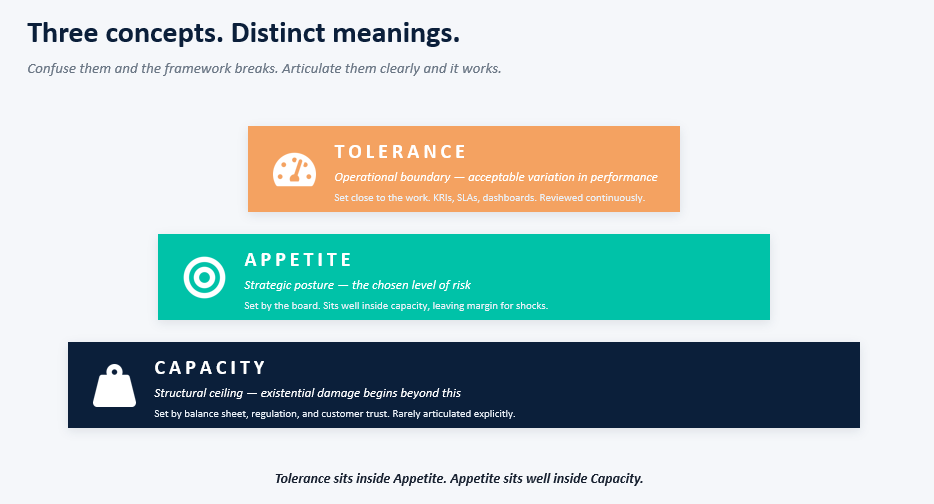
Three related but distinct concepts often get conflated in cybersecurity discussions, and the conflation produces real operational problems. Disentangling them is worth a few paragraphs.
Cybersecurity risk appetite is the strategic posture: the amount of cyber risk the organization is willing to accept in pursuit of its objectives. It is set at the enterprise level, owned at the executive level, articulated in the cyber appetite statements. It changes infrequently — annually, or when triggered by material change.
Cybersecurity risk tolerance is the operational expression: the boundaries of acceptable variation in performance, set closer to the work. A 99.95% Tier-1 availability appetite implies a monthly downtime tolerance of roughly 22 minutes; if a single business unit chronically exceeds that tolerance, the cumulative exposure approaches appetite breach. Tolerances live in the SLA tables, the patch policies, the access review schedules, and the dashboards. They are reviewed continuously.
Cybersecurity risk capacity is the structural limit: the amount of risk the organization could absorb without existential damage. Capacity is set by the balance sheet, the regulatory environment, the customer trust position, and the strategic horizon. Appetite sits inside capacity — typically well inside, leaving deliberate margin for shocks. An organization with a financial capacity of AED 500 million in cyber loss might set its appetite at AED 60 million, leaving AED 440 million of headroom for tail events, accumulating exposures, and unknown unknowns. Capacity is rarely articulated explicitly, but it is the implicit ceiling on how high appetite can sensibly go.
Appetite sets the ceiling the organization has chosen. Tolerance is how the ceiling is monitored in the noise of daily operations. Capacity is the ceiling beyond which existential damage begins. Confusing them is a sign that the framework has not yet been thought through. Articulating them clearly is a sign that it has.
5. Components of a Cyber Risk Appetite Statement
A cyber appetite statement that a security team can actually use contains four elements. Anything less leaves the statement aspirational; anything more tends to drift into a control catalogue rather than an appetite document.
Context
How the risk category relates to the business — which strategic objectives it supports or threatens, which regulatory regimes apply, which threat actors are most relevant, what is changing in the environment. Context grounds the statement in business reality and makes review meaningful when the environment shifts. Without context, the statement is portable in the worst sense — it could belong to any organization, which means it belongs to none.
The appetite statement
The specific posture — Zero, Low, Medium, or High — together with the explicit boundary conditions. "Low appetite for endpoint compromise" means nothing operationally. "Low appetite, defined as fewer than 1% of endpoints showing successful malware execution in any quarter, with zero lateral movement to crown-jewel assets" is something a SOC can monitor and a CISO can defend. The posture is qualitative; the boundary conditions are quantitative or behavioural; both are required.
Key risk indicators and limits
The measurable indicators that show whether the organization is operating inside appetite, approaching the boundary, or in breach. KRIs should be a small, curated set — typically three to five per risk category — drawn from data the organization already collects through its EDR, SIEM, vulnerability scanner, GRC platform, or vendor monitoring tooling. KRIs nobody can produce are worse than no KRIs at all, because they produce the illusion of measurement without the substance. A mature framework mixes leading and lagging indicators: lagging indicators show where the organization stands today; leading indicators show whether the trajectory points toward or away from an appetite breach.
Tripwires and consequences
What happens when an indicator approaches the appetite boundary, what happens when it crosses, who is notified at each stage, and what action is expected. Without tripwires, appetite is a passive document. With them, it becomes an active control over the security programme. Tripwires usually have three levels: an awareness threshold (indicator trending toward boundary, communicated to security leadership), an action threshold (indicator approaching boundary, formal management review and contingency activation), and a breach threshold (indicator past boundary, executive escalation and remediation plan to the audit or risk committee).
6. Cyber Risk Categories and Sample Statements
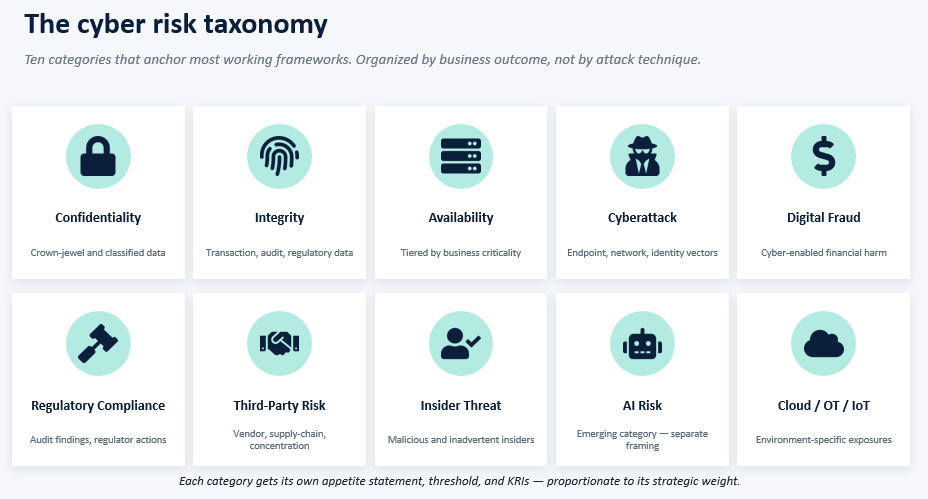
Different organizations structure their cyber risk taxonomy differently, but most converge on a similar set of categories. The table below offers a working example — a structure that has held up across multiple environments — with sample appetite statements and indicative KRIs. The thresholds shown are illustrative; in a real organization they would be calibrated to the enterprise risk appetite and the business model.
A few observations on this template. The categories deliberately avoid the temptation to organize by attack type. "Appetite for ransomware" is less useful than "appetite for production availability disruption," because the second remains relevant when the attack technique evolves. Appetite frameworks built around attacker techniques age quickly; frameworks built around business outcomes do not.
The KRIs are deliberately a mix of leading and lagging indicators. Lagging indicators tell the organization where it stands today. Leading indicators — dwell time, patch compliance, phishing click rates, vendor monitoring scores — tell it whether the trajectory points toward or away from an appetite breach. Both matter, and a dashboard built only on lagging indicators discovers problems too late.
The categories are not exhaustive. Organizations operating critical infrastructure typically add an OT/ICS category; organizations with significant cloud transformation programmes add a cloud-specific category; organizations with material AI exposure (covered in section 11) add an AI category. The principle is the same: each principal cyber risk gets its own statement, threshold, and indicators, with the depth of treatment proportionate to the strategic importance of the category.
7. Quantifying Cyber Risk Appetite: The FAIR Approach
Qualitative appetite bands — Zero, Low, Medium, High — get a framework off the ground. They are sufficient for many organizations and many risk categories. But at some point, particularly for the categories that contribute most to enterprise loss, qualitative bands stop being precise enough to support real decisions. "Low appetite" tells you the direction; it does not tell you whether AED 50 million of investment is justified or AED 5 million. For that, you need quantification.
Factor Analysis of Information Risk — FAIR — has emerged over the past decade as the most widely adopted quantitative methodology for cybersecurity risk. It is not the only approach, but it has earned its standing by being structurally sound, practically usable, and aligned with how risk is quantified in financial services, insurance, and operational risk more broadly. A CISO building a mature appetite framework needs at minimum a working understanding of FAIR, even if the deep analytical work sits elsewhere in the organization.
FAIR decomposes cyber risk into a small set of factors that can be estimated individually and combined into loss expectancy figures. The decomposition matters because it makes the estimation tractable. Asking "how much cyber risk do we have?" produces hand-waving; asking "what is the expected frequency of a ransomware event against our Tier-1 systems given our current control posture, and what is the expected loss magnitude when it occurs?" produces numbers that can be defended.
The core FAIR components are summarized below.
The output of a FAIR analysis is typically expressed as a loss exceedance curve — a probability distribution showing the likelihood of exceeding various loss levels in a given year. The curve is more informative than a single annual loss expectancy figure because it captures the shape of the risk, not just its expected value. Two risks with the same ALE can have very different curves: one steady and predictable, one dominated by a low-probability tail event. The appetite framework can address both shapes by setting an expected-value ceiling (a target for ALE) and a tail-risk ceiling (a target for the 95th or 99th percentile loss).
Quantification is not a panacea. Three caveats are worth bearing in mind. First, the output is only as good as the inputs, and many of the inputs involve genuine uncertainty. A FAIR model with overconfident inputs produces overconfident outputs; the discipline of expressing ranges rather than point estimates is essential. Second, quantification is most reliable where data is available — for high-frequency, lower-magnitude scenarios — and least reliable for the catastrophic tail events that often matter most. The model is a tool, not an oracle. Third, quantification can crowd out judgement if applied too rigidly. The numbers are inputs to a decision, not substitutes for it; the appetite framework should integrate quantitative analysis with qualitative posture rather than replace one with the other.
Used well, quantification transforms the conversation. A CISO who can sit with the CFO and walk through an ALE figure and the residual exposure relative to appetite is speaking a language the CFO understands. Investment decisions become tractable. Insurance discussions become precise. Board reporting acquires a credibility that qualitative reporting can never quite match.
8. Worked Examples: Quantified Appetite Statements
The table below illustrates how quantitative appetite statements drive practical decisions. Each example pairs an appetite ceiling with a modelled scenario and shows the treatment implication that follows. The numbers are illustrative; the logic is portable.
Three observations on the pattern these examples illustrate.
First, quantification makes treatment decisions almost mechanical. Once the appetite ceiling is set and the residual exposure is modelled, the decision logic is largely deterministic: if exposure is inside appetite, accept; if outside, treat, transfer, or terminate. The judgement lies in the modelling — which scenarios to include, what frequency and magnitude estimates to use, how to capture uncertainty — not in the comparison. This is what makes the framework scalable. The first risk decision takes weeks of analysis; the hundredth takes hours.
Second, quantification surfaces dominant scenarios. A single scenario typically drives a disproportionate share of the loss exceedance curve. Identifying it focuses treatment investment where it matters most. An organization that discovers its tail risk is driven 80% by a single ransomware-plus-extortion scenario should not be spread its treatment budget evenly across the cyber programme; it should concentrate it on backup integrity, segmentation, identity controls for privileged accounts, and IR readiness. The framework points to the answer.
Third, quantification makes the insurance conversation rational. Cyber insurance is most appropriately used for the tail of the loss exceedance curve — high-magnitude, low-probability events whose retention would breach appetite. The self-insurance retention is sized to sit inside appetite; the coverage limit is sized to cover the tail. Without quantification, this conversation is qualitative and approximate. With it, the policy structure follows logically from the appetite framework.
9. Cyber Appetite and the Risk Assessment Process
Once cyber appetite is set, the most immediate place it shows up is in the risk assessment process. This is where the framework either becomes operational or becomes decorative.
In a typical risk assessment methodology — whether ISO/IEC 27005, NIST SP 800-30, or a FAIR-based quantitative approach — risks are identified, analysed, evaluated, and then treated. The first three steps are largely technical exercises: identify the risk, estimate its likelihood and impact, and assign a score or distribution. The evaluation step is where appetite enters. Without an appetite framework, evaluation is essentially subjective: a risk owner decides whether the residual risk is "acceptable." Different owners make different judgements, and the risk register accumulates inconsistent acceptance decisions that are difficult to defend during an audit, an incident, or a board review.
With an appetite framework, evaluation becomes a comparison. A risk is acceptable if its residual exposure falls within the appetite for its category. It is treatable if it sits outside appetite but treatment is feasible at proportionate cost. It is escalable if it sits outside appetite and treatment is not feasible without executive sanction. The framework forces the conversation up to the level where it belongs and ensures that the same risk produces the same evaluation regardless of who is reviewing it.
Practical mechanics matter. Risk register columns should include the relevant appetite category and the appetite threshold alongside the inherent and residual risk scores. Heat maps should be coloured by appetite bands — green for inside appetite, amber for approaching boundary, red for in breach — rather than by inherent risk severity alone. Standing reports should show movement of risks against appetite over time, not just risk scores in isolation. The same conventions should be carried into board reporting so that the language is consistent from the analyst preparing the register to the chair reviewing the dashboard.
The cadence of risk assessment also benefits from appetite alignment. Risks that sit well inside appetite need lighter-touch review; risks that approach or breach appetite need active management. A risk register that treats every risk symmetrically wastes review effort on the well-controlled and underfunds attention on the genuinely exposed. Appetite-driven cadence concentrates the assessment effort where it produces decisions.
10. Cyber Appetite and Risk Treatment Decisions
Risk assessment identifies the position; risk treatment changes it. The four treatment options recognized by every major framework — treat (mitigate), transfer, tolerate, or terminate — are well established. What is less well established, in many organizations, is the disciplined logic that connects appetite position to treatment choice. The table below sets out the connection.
Several principles run through this treatment logic.
Treatment investment should be sized to the appetite gap, not to the inherent risk
A common error is to scale control investment to the size of the inherent risk — "this is a high-impact risk, therefore it deserves heavy investment." Appetite-driven treatment instead scales investment to the gap between residual exposure and appetite. A high-impact risk with controls that already bring residual exposure inside appetite needs no additional investment; a moderate-impact risk where residual exposure sits materially above appetite may justify substantial investment. The question is not how big the risk is, but how big the gap is.
Transfer is appropriate for the tail, not for the body
Cyber insurance and contractual transfer (vendor warranties, customer indemnities) are most appropriately used for the high-magnitude, low-probability tail of the loss exceedance curve. Treating these risks with controls is often disproportionately expensive; transferring them is usually cheaper. By contrast, transfer is rarely the right answer for high-probability, lower-magnitude risks; the premiums become prohibitive and the deductibles consume most of the loss anyway. The appetite framework should specify which risks are in scope for transfer and which are not.
Tolerance must be formal, not implicit
A risk that sits inside appetite is being tolerated. That tolerance is a decision, and it should be documented as one — with a documented rationale, a review date, and an owner accountable for monitoring the position. Implicit tolerance ("we never decided to accept this, it just hasn't been addressed") is the most common cause of unexplained exposure surfacing during incidents and audits. The appetite framework should produce explicit acceptance records for every risk that is tolerated, and those records should be revisited on a defined cadence.
Termination is a real option, not a theoretical one
Some risks cannot be brought inside appetite at proportionate cost. When that is the case, the organization has three choices: accept the position formally (with executive or board override), redesign the activity to lower the risk (which may amount to partial termination), or stop the activity altogether (full termination). Many CISOs treat termination as unmentionable, on the assumption that business leadership will never accept it. In practice, an honest conversation about termination — supported by quantified data and clear appetite reference — is one of the most powerful tools a CISO has. The conversation does not always end in termination, but the fact that termination is on the table changes the dynamic of every other option.
11. Linking Cyber Appetite to Other Cybersecurity Initiatives
A cyber appetite framework that lives only in the risk register is doing a fraction of its potential work. The full value emerges when the framework becomes the connective tissue between every other element of the cybersecurity programme — control selection, vulnerability management, incident response, vendor governance, identity, cloud, architecture, insurance, awareness, and board reporting. Each of these initiatives should be a coherent expression of the same underlying appetite.
The pattern across these initiatives is consistent. Appetite tells the security function where to invest its limited resources, which controls to apply at which depth, how quickly to react when something deviates, and how to explain its choices to people outside the security organization. A CISO who can map every major decision back to a board-approved appetite category has a programme that is both defensible and adaptable. A CISO who cannot is running a programme on personal judgement, which works until the day it does not.
12. Regulatory Alignment: Mapping to Local and International Frameworks
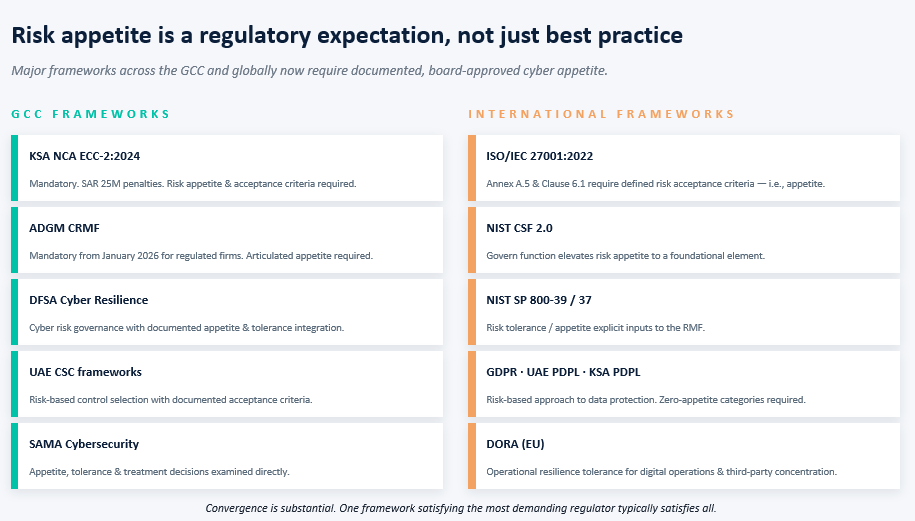
Cyber risk appetite is increasingly a regulatory expectation, not just a management best practice. Across the GCC and internationally, supervisors have moved toward requiring explicit, documented, board-approved cyber risk appetite as a foundation of the overall risk management programme. CISOs operating in regulated industries need to know not only how to build the framework but also how to demonstrate it during examinations.
The table below maps cyber appetite requirements across the major frameworks a CISO is likely to encounter in the GCC and globally.
Two themes emerge from this mapping. First, the convergence is substantial. Different regulators in different jurisdictions are arriving at similar expectations: documented appetite, board approval, integration with the broader risk framework, and demonstrable use in operational decisions. A CISO who builds one framework that satisfies the most demanding regulator in their portfolio will typically satisfy all of them. There is little value in maintaining separate appetite frameworks for separate regimes.
Second, the bar is rising. Frameworks that were principles-based five years ago are becoming prescriptive. NCA ECC-2:2024 specifies enforcement, ADGM CRMF moves to mandatory status in January 2026, NIST CSF 2.0 elevates Govern as a peer function, and ISO 27001:2022 sharpens the requirements around risk acceptance criteria. Organizations that have not begun the appetite work are not catching up to a stationary target; they are catching up to one that is accelerating. Starting now is materially cheaper than starting later.
13. Emerging Domains: AI Risk Appetite
The arrival of generative AI as a mainstream technology has created a category of cyber risk that did not exist three years ago. CISOs cannot extend their existing appetite framework to cover AI by adding a single line; the technology raises issues across confidentiality, integrity, availability, regulatory compliance, ethics, and reputational exposure simultaneously. A separate, deliberately designed AI risk appetite section is now standard practice in mature frameworks.
The AI risk surface has several distinct dimensions that the appetite framework must address. AI tools used internally for productivity create data leakage risk if confidential information is submitted to third-party services. AI models embedded in business processes create decision risk if their outputs influence customer outcomes without adequate review. AI systems themselves create a new attack surface — prompt injection, model theft, data poisoning, supply chain attacks on model providers. AI used defensively in the SOC creates automation risk if false positives drive unjustified action or false negatives mask real attacks. Shadow AI — unsanctioned use by employees — creates governance risk that organizations are only beginning to address.
The table below provides a working structure for AI risk appetite, organized by use context rather than by AI technology. Organizing by use context matters because the same technology can present very different risk profiles depending on where it is deployed.
Two implementation notes. First, AI appetite should be set early in the technology's lifecycle within the organization, not retrofitted after adoption has spread. Once employees are using a particular AI tool routinely, restricting it becomes a change management problem rather than a policy problem. The window for proactive appetite-setting is short.
Second, AI appetite should be reviewed more frequently than other categories. The technology is moving quickly, the regulatory environment is moving quickly, and attacker techniques against AI are emerging quickly. An annual review cycle is too slow for a category evolving this fast. A six-month review cycle is more appropriate, with event-driven review when material capability or regulatory changes occur.
14. The Cyber Risk Appetite Maturity Model
Building a cyber risk appetite framework is a journey, not a one-time project. The framework that an organization deploys in year one is rarely the framework it operates with in year five. Maturity grows through use — through the experience of applying the framework to real decisions, finding its weak points, refining the categories, sharpening the indicators, and deepening the integration with adjacent processes. The model below describes the typical progression and helps CISOs locate their organization on the curve.
A few observations on the maturity progression.
The transition from Level 2 to Level 3 is the hardest. Many organizations stall at Level 2 indefinitely, with a generic appetite statement that nobody references. The transition requires sustained executive sponsorship, joint development with enterprise risk management, and the discipline to push beyond generic language to category-specific thresholds. Without explicit attention, organizations remain at Level 2 by default; they reach Level 3 only by deliberate effort.
Quantification is not a prerequisite for usefulness. A well-structured Level 3 framework — qualitative thresholds, clear KRIs, integration with the risk register, periodic board reporting — produces most of the operational benefit. Quantification (Level 4 and 5) adds precision and unlocks particular decisions (insurance, capital allocation, M&A) but is not where the bulk of the value sits. Organizations that defer Level 3 until they can achieve Level 4 quantification typically achieve neither. Build the qualitative framework first; layer quantification on top of it later.
Level 5 is rare. Most mature organizations operate at a strong Level 3 or a moderate Level 4. Level 5 — full FAIR integration, loss exceedance curves, appetite-driven capital allocation, continuous calibration — requires substantial analytical capability and is appropriate primarily for organizations where cyber risk is a top-three enterprise risk. Aspiring to Level 5 without the underlying business case is a misuse of effort. The right level for most organizations is the level at which the marginal benefit of further maturity exceeds the marginal cost — and that point varies.
15. The CISO's Implementation Playbook
Standing up a cyber appetite framework from scratch is not a one-quarter exercise. The framework itself can be drafted in weeks, but embedding it across the security programme and earning genuine adoption typically takes two to four quarters. The sequence below has held up across multiple deployments and is offered as a working playbook.
- Discover the enterprise risk appetite. Before drafting anything cyber-specific, read the board-approved enterprise risk appetite framework, the principal risk taxonomy, the latest ERM report, and the audit committee minutes for the past four quarters. Understand what the board has already approved and where it has expressed unease. Skipping this step produces a cyber framework that does not align with what is already in place.
- Engage the Chief Risk Officer or head of enterprise risk. Position the cyber appetite work as a cascade of the enterprise framework, not as a parallel initiative. Agree the principal cyber risk categories, the translation logic from enterprise to cyber, and the governance for sign-off. Without this alignment, the cyber framework will arrive at the board as a competing document rather than a complementary one.
- Map the cyber risk taxonomy. Define the cyber risk categories the framework will cover. Eight to twelve categories is a workable range — fewer and the framework loses precision, more and it becomes unwieldy. Anchor the taxonomy to business outcomes, not attack techniques.
- Draft the appetite statements through business workshops. The risk team should not write the statements alone. Run focused workshops with the relevant business owners — application owners for availability, data owners for confidentiality, the CFO's organization for fraud, the General Counsel for regulatory and ethical categories. Capture the thresholds in their language; refine in the security team's language afterwards.
- Quantify where the data supports it. For categories where loss data exists — fraud, regulatory penalties, downtime cost — express the appetite in monetary terms alongside the qualitative band. For categories where data is thin, qualitative bands with concrete behavioural thresholds remain valid. Avoid the trap of using quantification as a substitute for judgement; quantification is a complement to judgement, not a replacement.
- Define KRIs against the data the organization already collects. Resist the urge to specify indicators that require new tooling. Most organizations have richer telemetry than they realize from their EDR, SIEM, vulnerability scanners, IAM systems, and GRC platforms. New KRIs that need new instrumentation rarely survive the first year.
- Establish tripwires and escalation paths. For each category, define the level at which the indicator triggers a management review and the level at which it triggers executive escalation. Document who is notified, in what timeframe, and with what supporting context. Tripwires without documented response become alarms that fatigue the organization.
- Secure board approval. Present the framework to the audit committee or risk committee with the explicit linkage to the enterprise risk appetite. Frame the discussion around the categories where the cyber posture is tighter or looser than they might assume, and invite challenge. Approved appetite that has been actively debated by the board is far more durable than approved appetite that has been rubber-stamped.
- Embed the framework in the GRC tooling and operational processes. Update the risk register schema to capture appetite category and threshold. Recolour heat maps. Adjust patch SLAs, vendor tiering criteria, IR severity definitions, IAM policy scopes, and architecture standards to reflect appetite. Each embedding is small; cumulatively they are how the framework becomes real.
- Set a review cadence and stick to it. Annual review at minimum, supplemented by event-driven review whenever the threat landscape, regulatory environment, business strategy, or organizational structure changes materially. A stat