

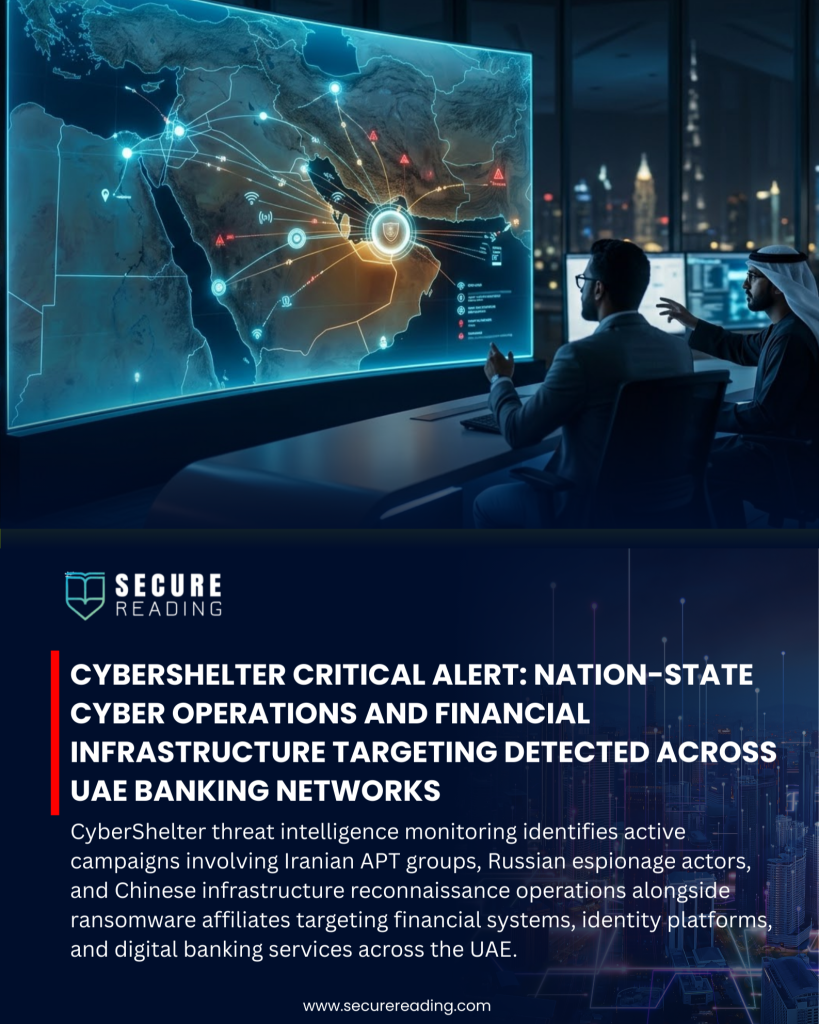
CyberShelter CRITICAL Alert: Nation-State Cyber Operations and Financial Infrastructure Targeting Detected Across UAE Banking Networks
CyberShelter threat intelligence monitoring identifies active campaigns involving Iranian APT groups, Russian espionage actors, and Chinese infrastructure reconnaissance operations alongside ransomware affiliates targeting financial systems, identity platforms, and digital banking services across the UAE.
Date: March 12, 2026
Classification: TLP:AMBER
Threat Level:CRITICAL
Framework: MITRE ATT&CK v17
Source: CyberShelter Threat Intelligence & NSOC
Executive Summary
CyberShelter threat intelligence monitoring indicates that the financial sector in the United Arab Emirates is facing a heightened cyber threat environment driven by a combination of geopolitical tensions, nation-state cyber operations, and ransomware activity.
Recent intelligence collected across threat intelligence platforms and OSINT sources shows:
- Active command-and-control (C2) infrastructure targeting financial organizations
- Credential spraying campaigns against enterprise identity systems
- Pre-positioning activity linked to destructive malware operations
- Increased reconnaissance activity against financial infrastructure
Multiple advanced persistent threat (APT) groups linked to Iran, Russia, and China, along with financially motivated ransomware groups, are currently active in the region.
The combination of nation-state espionage operations and ransomware activity increases the likelihood of both data-theft incidents and disruptive attacks targeting financial services.
Nation-State Threat Actors Targeting Financial Infrastructure
CyberShelter monitoring has identified multiple advanced threat actors conducting reconnaissance and intrusion attempts against financial institutions.
Iranian Cyber Operations
Iranian state-aligned threat actors remain among the most active adversaries targeting organizations across the Middle East.
MuddyWater Operations
MuddyWater, a threat group linked to the Iranian Ministry of Intelligence and Security, continues to deploy multi-stage malware campaigns using both custom tools and legitimate remote management software.
Typical intrusion lifecycle observed:
- Reconnaissance through open-source intelligence
- Spear-phishing delivery of malicious documents
- Abuse of remote monitoring tools for persistence
- Data exfiltration to cloud storage services
Indicators associated with MuddyWater infrastructure include multiple command-and-control servers and malware implants observed in regional networks.
OilRig / APT34 Activity
APT34 continues to target financial infrastructure and identity systems.
Recent campaigns include attempts to exploit vulnerabilities affecting enterprise security appliances and network infrastructure.
Examples of vulnerabilities exploited in previous campaigns include:
- VPN and gateway vulnerabilities
- Web server remote code execution flaws
- Network security appliance misconfigurations
These campaigns often aim to obtain credentials and maintain long-term access inside enterprise networks.
Russian Cyber Espionage Activity
Russian threat actors continue to conduct cyber espionage operations targeting financial and government-related systems.
Groups linked to Russian intelligence services have historically deployed destructive malware capable of disrupting financial operations and industrial systems.
Indicators associated with these campaigns include command-and-control servers, destructive malware families, and network-level reconnaissance activity.
Chinese Infrastructure Pre-Positioning
Threat actors linked to China continue to conduct long-term reconnaissance operations against critical infrastructure.
Groups such as Volt Typhoon are known for living-off-the-land techniques, which rely on legitimate system tools to avoid detection while maintaining persistent access inside networks.
Such campaigns often aim to establish footholds that could be used during future geopolitical escalation.
Ransomware Activity Targeting Financial Organizations
CyberShelter monitoring also indicates continued ransomware activity targeting financial infrastructure.
Several ransomware groups are actively targeting enterprise environments using techniques such as:
- Exploitation of remote access vulnerabilities
- Credential theft and privilege escalation
- Targeting virtualization platforms such as ESXi
These operations are increasingly linked with initial access brokers who sell network access to ransomware operators.
Emerging Threat: Surveillance Infrastructure Exploitation
Security research has identified increased exploitation attempts targeting network-connected surveillance devices.
These devices may include IP cameras and related monitoring infrastructure used across financial institutions and commercial facilities.
Attackers may attempt to compromise these systems to gain visibility into facilities or pivot into internal networks.
Organizations operating such systems should ensure that:
- Devices are not exposed directly to the internet
- Firmware updates are applied
- Default credentials are removed
- Devices are segmented from corporate networks
Defensive Actions for Security Teams
CyberShelter recommends that financial sector organizations implement the following defensive measures immediately.
Identity Security
- Enforce multi-factor authentication across all privileged accounts
- Monitor identity systems for credential spraying attempts
- Conduct periodic credential rotation
Infrastructure Security
- Apply security patches for network appliances and critical systems
- Implement network segmentation for sensitive systems
- Restrict remote access tools and monitor for unauthorized use
Threat Detection
- Deploy endpoint detection and response monitoring
- Integrate threat intelligence feeds into SIEM systems
- Conduct proactive threat hunting for known indicators
CyberShelter Strategic Assessment
CyberShelter assesses the current cyber threat environment affecting the UAE financial sector as high risk due to the convergence of multiple factors:
- Nation-state cyber espionage operations
- Hacktivist activity linked to geopolitical tensions
- Ransomware campaigns targeting enterprise infrastructure
- Supply-chain and infrastructure targeting attempts
Organizations should assume that persistent intrusion attempts will continue and adjust their defensive posture accordingly.
The most effective defensive strategy combines:
- continuous monitoring
- proactive threat hunting
- strong identity protection
- integration of threat intelligence into security operations
Conclusion
The UAE financial sector remains a strategic target due to its economic significance and global connectivity.
Organizations that maintain strong visibility across their infrastructure, integrate threat intelligence into their security operations, and strengthen identity protection controls will be best positioned to defend against evolving cyber threats.
CyberShelter continues to monitor regional cyber activity and provide intelligence-driven support to organizations across the Middle East.
Need Strategic Support?
CyberShelter NSOC provides 24/7 incident response, threat hunting, and threat intelligence services for organizations facing advanced cyber threats.