

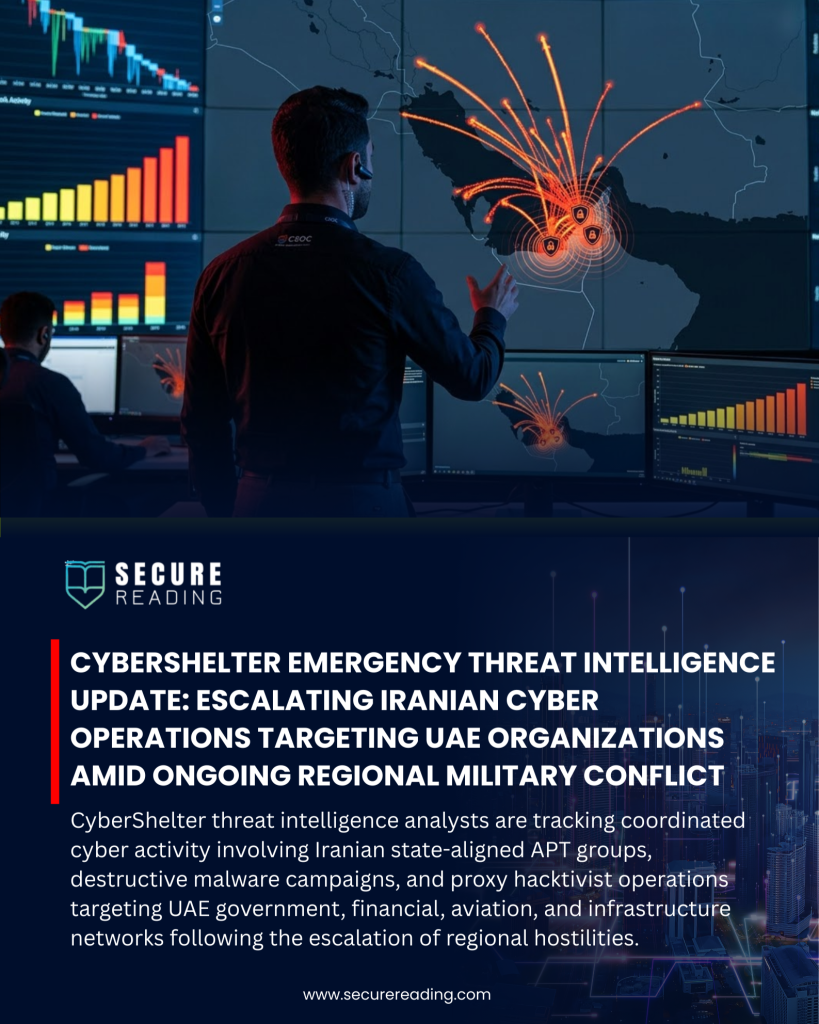
CyberShelter Emergency Threat Intelligence Update: Escalating Iranian Cyber Operations Targeting UAE Organizations Amid Ongoing Regional Military Conflict
CyberShelter threat intelligence analysts are tracking coordinated cyber activity involving Iranian state-aligned APT groups, destructive malware campaigns, and proxy hacktivist operations targeting UAE government, financial, aviation, and infrastructure networks following the escalation of regional hostilities.
Threat Level: CRITICAL
Conflict Status: ACTIVE REGIONAL CONFLICT
Published: 13 March 2026
Version: 1.0 – LIVE ADVISORY
Source: CyberShelter Threat Intelligence & NSOC
Conflict Trigger
On 28 February 2026, the United States and Israel launched coordinated military operations known as Operation Epic Fury / Operation Roaring Lion, targeting Iranian nuclear infrastructure, military leadership, and strategic facilities.
Following these strikes, Iran initiated retaliatory missile, drone, and cyber operations across the Middle East, targeting multiple countries including:
- United Arab Emirates
- Bahrain
- Qatar
- Kuwait
- Saudi Arabia
- Jordan
- Israel
Cyber operations began simultaneously with kinetic military retaliation, marking the start of an active hybrid conflict environment combining physical warfare and cyber operations.
Situation Overview: UAE Under Active Cyber Targeting
CyberShelter threat intelligence monitoring confirms that UAE organizations are currently within the targeting scope of multiple Iranian cyber actors and affiliated hacktivist groups.
This is not a theoretical risk scenario. Multiple incidents affecting UAE infrastructure have already been observed.
Confirmed Cyber Activity (28 Feb – 13 Mar 2026)
Intelligence Assessment
CyberShelter assesses that UAE organizations are facing a multi-layer cyber threat environment driven by regional conflict escalation.
Three attack layers are currently active:
1. Hacktivist Disruption Operations
- DDoS attacks
- Website defacements
- Psychological influence campaigns
2. Espionage and Network Intrusions
- MuddyWater implants pre-positioned in networks
- Credential harvesting and long-term reconnaissance
3. Destructive Cyber Operations
- Wiper malware
- ransomware-wiper hybrids
- infrastructure sabotage attempts
Threat intelligence partners including Cisco Talos, Palo Alto Unit 42, and BeyondTrust assess the next 14–30 days as the highest risk period for escalation.
Why the UAE Is Being Targeted
Iranian cyber strategy targets countries based on geopolitical alignment and strategic impact.
Several factors place UAE organizations in a high-priority targeting category.
Strategic Drivers
Military Alignment
The UAE hosts major U.S. military assets and CENTCOM operations, making it a retaliatory target.
Abraham Accords
UAE normalization with Israel places it within Iran’s perceived regional adversary coalition.
Regional Financial Hub
Disruption of UAE financial infrastructure would create significant geopolitical and economic impact.
Energy Infrastructure
UAE oil and gas infrastructure remains a long-standing target for Iranian cyber actors.
Aviation and Logistics
Airports and logistics hubs are strategic targets capable of disrupting regional supply chains.
Iranian Cyber Threat Ecosystem Targeting the UAE
Iran’s cyber operations involve both state-directed APT groups and affiliated hacktivist proxies.
Key Threat Actors
Destructive Malware Threats in the Current Conflict
Several destructive malware families associated with Iranian actors are active in the current threat landscape.
ZeroShred Wiper
Associated with Void Manticore / Handala Hack
Capabilities:
- Large-scale device wipe operations
- Credential theft using Rhadamanthys infostealer
- Abuse of Microsoft Intune device management systems
A recent attack wiped over 200,000 managed devices globally using this technique.
Sicarii Ransomware-Wiper
- Appears as ransomware but destroys decryption keys
- Victims cannot recover data even if ransom is paid
- Targeting organizations across the Middle East, Turkey, and Africa
Agrius Pseudo-Ransomware Campaigns
Malware used:
- DEADWOOD
- Apostle
- Fantasy wiper
These attacks disguise destructive malware as ransomware to delay response and create confusion.
Active Campaign: Operation Olalampo (MuddyWater)
CyberShelter monitoring confirms Operation Olalampo, an active MuddyWater campaign targeting organizations across the Middle East including the UAE.
Attack Chain
- Spear-phishing emails with malicious Office attachments
- Macro-based execution of initial payload
- Deployment of GhostFetch downloader
- Installation of GhostBackDoor or CHAR backdoor
- Persistence using AnyDesk RMM tools
- Data exfiltration via Rclone to cloud storage
Newly Observed Malware
Key Indicators of Compromise (IOCs)
Organizations should immediately monitor or block the following indicators.
C2 Infrastructure
- codefusiontech[.]org
- handala-hack[.]to
- handala-redwanted[.]to
Malware Indicators
- FMAPP.dll
- gshdoc_release_X64_GUI.exe
- sh.exe
Suspicious Tools
- Rclone with Wasabi cloud storage
- Unexpected AnyDesk installations
- Deno runtime execution
Actively Exploited Vulnerabilities
Iran-linked threat actors are exploiting several known vulnerabilities affecting surveillance devices and enterprise infrastructure.
Many of these vulnerabilities allow unauthenticated access to live camera feeds or full remote code execution.
Immediate Security Actions for UAE Organizations
Priority 1 (Within 24 Hours)
- Harden Microsoft Intune administrative access
- Block known command-and-control infrastructure
- Disable Office macros from internet sources
- Audit Hikvision and Dahua surveillance devices
- Enforce phishing-resistant MFA for administrators
Priority 2 (Within 72 Hours)
- Verify offline and air-gapped backups
- Audit remote management tools
- Patch internet-facing infrastructure
- Review Intune device enrollment policies
Priority 3 (Within 7 Days)
- Implement IT / OT network segmentation
- Conduct destructive attack tabletop exercises
- Review supply chain exposure
- Strengthen threat intelligence sharing
CyberShelter Intelligence Assessment
CyberShelter assesses the current cyber threat landscape affecting the UAE as CRITICAL.
The combination of:
- Active military conflict
- Iranian cyber retaliation doctrine
- Pre-positioned espionage implants
- Hacktivist mobilization
- destructive malware capability
creates an environment where rapid escalation of cyber attacks is highly likely.
Organizations should transition from passive monitoring to active threat hunting and resilience planning.
Need Immediate Assistance?
CyberShelter NSOC provides 24/7 incident response, threat hunting, and cyber crisis support for organizations facing nation-state cyber threats.
Contact CyberShelter NSOC for emergency support.