

U.S. Blocks Foreign-Made Routers Over Rising Cybersecurity Risks
U.S. moves to block high-risk routers as cyber threats shift toward infrastructure-level attacks.
A Major Shift in Cybersecurity Policy
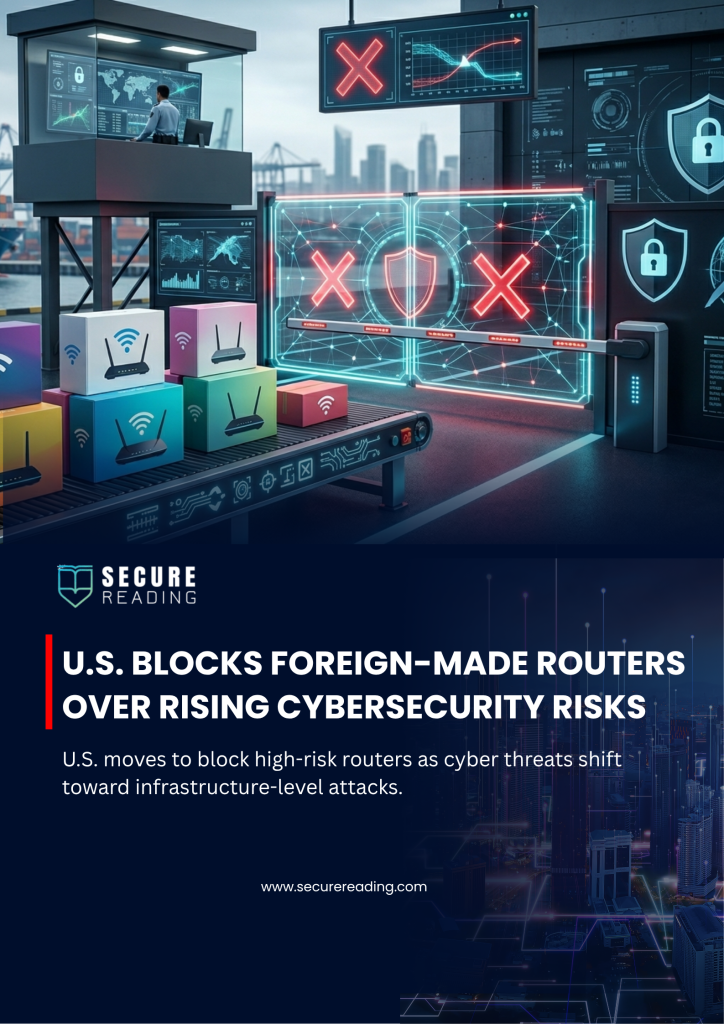
The U.S. Federal Communications Commission (FCC) has announced a major decision. It will ban the import and sale of new foreign-made consumer routers.
This move follows growing concerns about supply chain vulnerabilities and national security risks. According to FCC Chairman Brendan Carr, the decision aims to protect critical communications infrastructure across the country.
As a result, new router models manufactured outside the U.S. will no longer qualify for approval. This means they cannot be marketed or sold unless they pass strict security checks.
Why Routers Are Now a High-Risk Target
Routers sit at the center of every network. Therefore, attackers see them as powerful entry points.
Security agencies have identified multiple risks linked to foreign-made routers:
- Hidden supply chain vulnerabilities
- Weak security configurations
- Potential backdoors or firmware manipulation
Threat actors often exploit these weaknesses. Once compromised, routers can:
- Enable network surveillance
- Steal sensitive data
- Launch further attacks داخل networks
In many cases, attackers also use them to build botnets. These botnets help carry out password spraying and large-scale cyberattacks.
Link to Advanced Threat Campaigns
The decision also connects to ongoing cyber campaigns. Groups such as Volt Typhoon, Flax Typhoon, and Salt Typhoon have exploited vulnerable routers.
These actors target critical sectors, including:
- Energy
- Transportation
- Water systems
- Communications infrastructure
For example, in Salt Typhoon operations, attackers used compromised routers to move داخل networks. They maintained long-term access and pivoted between systems.
Additionally, a botnet known as CovertNetwork-1658 has enabled stealthy password spraying attacks. Security teams link this activity to a threat actor tracked as Storm-0940.
What the New FCC Rules Mean
Under the updated policy, all foreign-made consumer routers are now placed on the Covered List.
However, vendors can still apply for Conditional Approval. They must prove that their products do not introduce security risks.
Currently, only a limited number of technologies have received approval. These include systems from:
- SiFly Aviation
- Mobilicom
- ScoutDI
- Verge Aero
Notably, routers from Starlink are exempt. These devices are manufactured داخل the United States.
Importantly, this rule does not affect routers already in use. Retailers can also continue selling previously approved models.
Business Impact and Global Implications
This decision reflects a larger global trend. Governments are tightening control over technology supply chains.
For organizations, especially in regions like the UAE and GCC, this raises key questions:
- Are your network devices sourced from trusted vendors?
- Do you have visibility into firmware and updates?
- Can your infrastructure detect router-level compromises?
Meanwhile, attackers are shifting focus. Instead of targeting endpoints alone, they now aim for network infrastructure. This makes routers a critical security priority.
What Organizations Should Do Next
To reduce risk, organizations should act proactively:
- Audit all network devices and vendors
- Replace outdated or unsupported routers
- Segment networks to limit lateral movement
- Monitor unusual traffic patterns
- Apply firmware updates regularly
Additionally, companies should align with zero trust principles. Never assume network devices are secure by default.