

Fragnesia Linux Flaw Lets Attackers Gain Root Access Through Kernel Explit
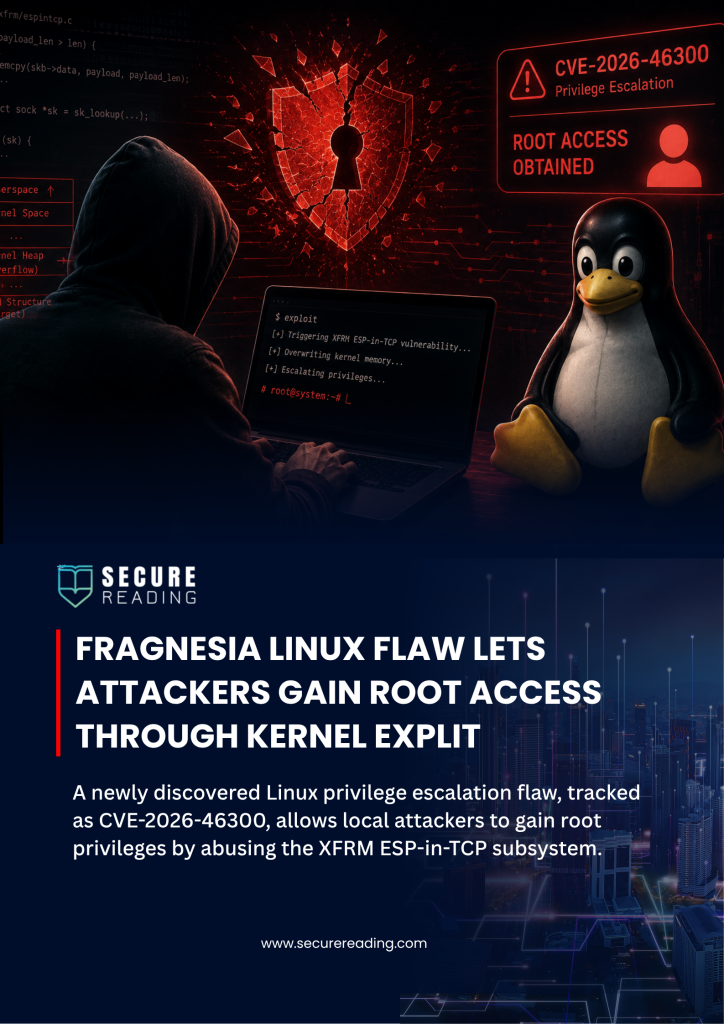
A newly discovered Linux privilege escalation flaw, tracked as CVE-2026-46300, allows local attackers to gain root privileges by abusing the XFRM ESP-in-TCP subsystem.
What Is the Fragnesia Vulnerability?
Linux administrators are facing another serious security issue. Researchers have disclosed a high-severity privilege escalation flaw called Fragnesia, tracked as CVE-2026-46300.
This vulnerability affects Linux kernels released before May 13, 2026. It allows local attackers to gain full root access on vulnerable systems.
Security researcher William Bowling, Head of Assurance at Zellic, discovered the issue. He also published a proof-of-concept exploit that shows how attackers can overwrite critical kernel memory and take full control of a system.
How the Attack Works
The flaw exists in the Linux XFRM ESP-in-TCP subsystem. This subsystem handles encrypted traffic used by IPsec VPN connections.
Because of a logic bug, unprivileged local users can write arbitrary bytes into the kernel page cache of read-only files. As a result, attackers can modify protected binaries in memory without changing them on disk.
In the public demonstration, the exploit targets the /usr/bin/su binary. By corrupting its page cache memory, the attacker can run malicious code and instantly gain a root shell.
Unlike many kernel exploits, this attack does not require race conditions. Therefore, it becomes easier to execute and more reliable for attackers.
Connection to the Dirty Frag Class
Researchers placed Fragnesia in the same “Dirty Frag” vulnerability class that was disclosed recently.
However, Dirty Frag required two separate flaws to work together. It chained CVE-2026-43284 and CVE-2026-43500 to achieve privilege escalation.
Fragnesia works as a standalone vulnerability. This makes it especially dangerous because attackers need fewer steps to reach root access.
According to Bowling, the flaw is separate but exists in the same attack surface. The mitigation approach is also the same.
Why Immediate Patching Matters
Linux distributions are now releasing emergency kernel patches. Administrators should apply them as quickly as possible.
Systems running enterprise workloads, cloud platforms, VPN gateways, and backend services face the highest risk if left unpatched.
If immediate patching is not possible, temporary mitigation includes removing vulnerable kernel modules. However, this may break AFS distributed file systems and IPsec VPN services.
Organizations must balance security protection with operational impact before using this workaround.
Growing Pressure on Linux Security Teams
This disclosure comes while Linux teams are still handling another privilege escalation issue called Copy Fail.
The Cybersecurity and Infrastructure Security Agency (CISA) recently added Copy Fail to its Known Exploited Vulnerabilities Catalog. Federal agencies were ordered to secure affected systems quickly.
The rise of these root privilege escalation flaws shows a growing problem for Linux environments. Attackers continue to target local privilege escalation because it provides fast access to complete system compromise.
Organizations should treat Fragnesia as a priority threat. Immediate patching, kernel monitoring, access reviews, and stronger endpoint detection are now critical steps.