

How Attackers Move Inside a Network: Understanding Lateral Movement
Most cyberattacks fail at the perimeter — the real damage happens after attackers get inside.
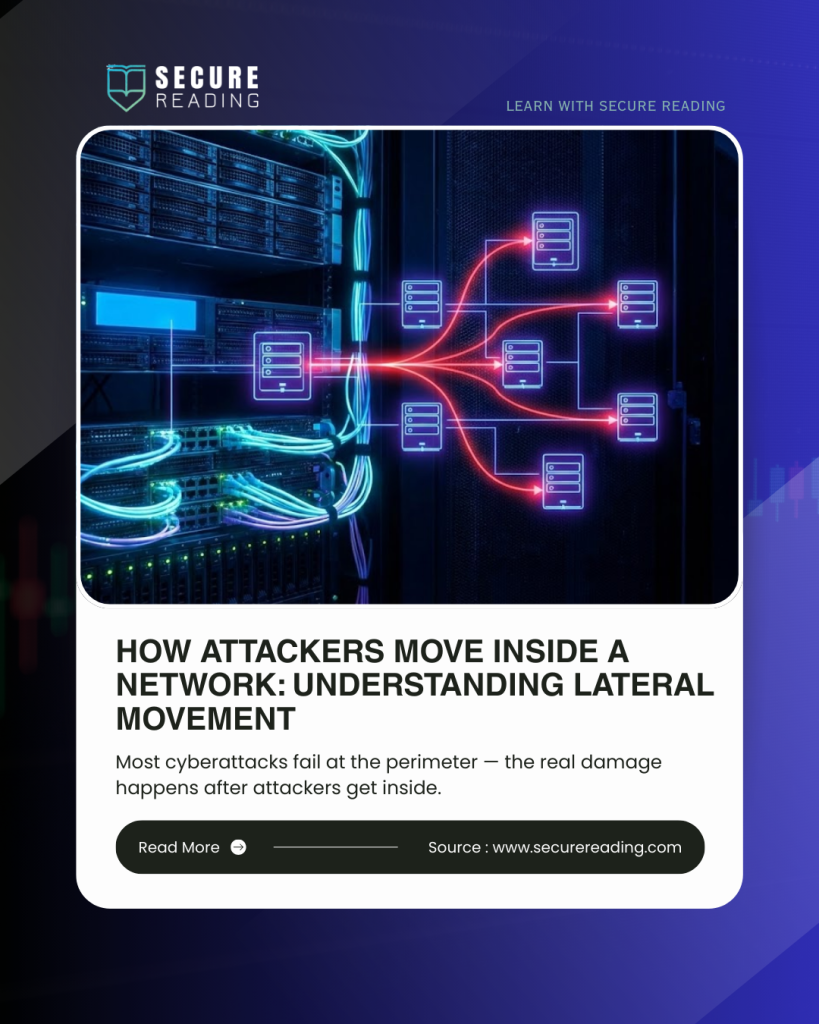
Lateral movement is the phase of a cyberattack where an attacker, after gaining initial access, moves from one system to another inside the network. Instead of attacking everything at once, attackers advance step by step, searching for higher privileges, sensitive data, and critical systems. Understanding this stage is essential for modern defense.
Initial access often happens through phishing, stolen credentials, or exposed services. However, that first foothold usually provides limited access. Therefore, attackers must move laterally to reach valuable assets such as domain controllers, databases, or cloud management consoles.
Attackers commonly use built-in system tools for lateral movement. They abuse remote desktop services, Windows administrative shares, PowerShell, and credential dumping techniques. Because these tools appear legitimate, traditional security tools may not raise alerts. As a result, attackers blend into normal network activity.
Credential reuse plays a major role. Many organizations reuse local administrator passwords or grant excessive privileges. Consequently, once attackers obtain one set of credentials, they can access multiple systems without resistance.
Lateral movement also occurs in cloud environments. Attackers pivot between workloads, steal access tokens, and abuse overly permissive identities. Because cloud activity relies heavily on APIs, attackers can move quickly and quietly if logging and monitoring remain weak.
Defending against lateral movement requires visibility. Security teams must monitor authentication behavior, privilege changes, and remote access patterns. Network segmentation, least-privilege access, and strong identity controls significantly reduce attacker mobility.
The goal is not to stop every initial intrusion. Instead, effective defense focuses on limiting how far attackers can go. When lateral movement fails, attackers often abandon the attack.
Understanding lateral movement shifts security thinking from perimeter defense to internal resilience. It helps teams design controls that assume compromise and still protect critical assets.