

Passwords Are Dead: Introduction to Modern Authentication Methods
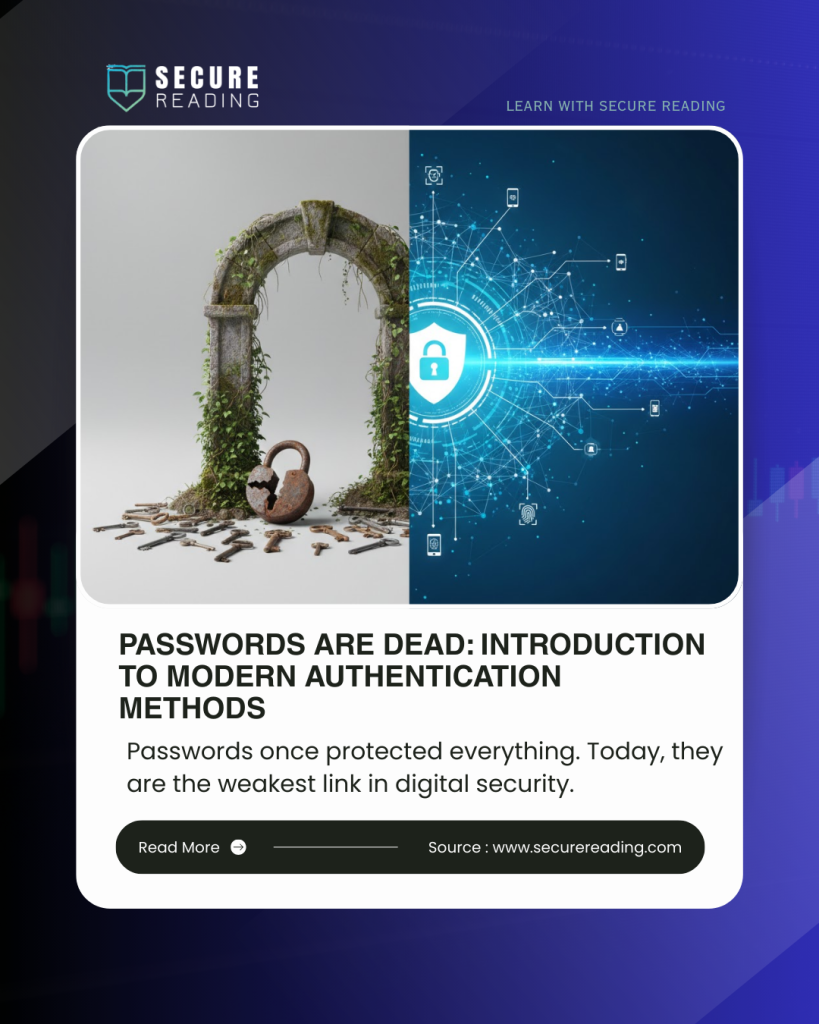
Passwords once protected everything. Today, they are the weakest link in digital security.
Why Passwords No Longer Work
Attackers rarely “hack” systems directly anymore. Instead, they log in. Phishing, credential stuffing, password reuse, and data breaches have made passwords easy to steal and cheap to abuse.
Even strong passwords fail when:
- Users reuse them across services
- Phishing pages capture them in real time
- Malware logs keystrokes
- Breached databases leak hashes
As a result, identity has become the primary attack surface.
The Shift From Secrets to Proof
Modern authentication moves away from shared secrets and toward proof of identity. Instead of asking “what do you know,” systems now ask:
- What do you have?
- Who are you?
- What behavior looks normal?
This shift reduces reliance on memorization and increases resistance to theft.
Multi-Factor Authentication (MFA)
MFA adds additional verification beyond a password. It significantly reduces account takeover risk when implemented correctly.
Common MFA factors include:
- Authenticator apps
- Hardware security keys
- Biometrics
- Push notifications
However, not all MFA is equal. SMS-based MFA remains vulnerable to SIM swapping and interception.
Passwordless Authentication
Passwordless systems remove passwords entirely. Users authenticate using device-bound credentials or cryptographic keys.
Popular passwordless approaches include:
- Passkeys
- Hardware tokens
- Platform authenticators tied to devices
Because there is no reusable secret, phishing attacks largely fail.
Biometrics: Convenience With Caution
Biometrics such as fingerprints and facial recognition improve usability. They authenticate the user locally and unlock cryptographic credentials.
However, biometrics should protect keys, not replace them. Unlike passwords, biometric traits cannot be changed if compromised.
Adaptive and Risk-Based Authentication
Modern systems evaluate context continuously. They consider device health, location, behavior, and access patterns.
If risk increases, systems can:
- Require stronger verification
- Block access
- Step up authentication dynamically
This approach balances security and user experience.
Zero Trust and Identity-Centric Security
Zero Trust models assume no implicit trust. Every access request must prove identity and authorization, regardless of location.
In this model:
- Identity replaces the network perimeter
- Authentication happens continuously
- Access becomes granular and temporary
Strong authentication becomes foundational, not optional.
What Organizations Should Do Next
Modern authentication requires planning, not just technology.
Key steps include:
- Reducing password dependency
- Enforcing phishing-resistant MFA
- Adopting passwordless where possible
- Monitoring identity behavior
- Educating users on login threats
Progress matters more than perfection.
The Bottom Line
Passwords are not “dead” everywhere, but they are no longer sufficient. Attackers understand this and exploit identity relentlessly.
Organizations that modernize authentication reduce breaches, improve user experience, and strengthen trust.
Identity is the new perimeter. How you protect it defines your security posture.