

What Is Multi-Factor Authentication (MFA) and Why It Matters
One Password Is No Longer Enough in Today’s Threat Landscape
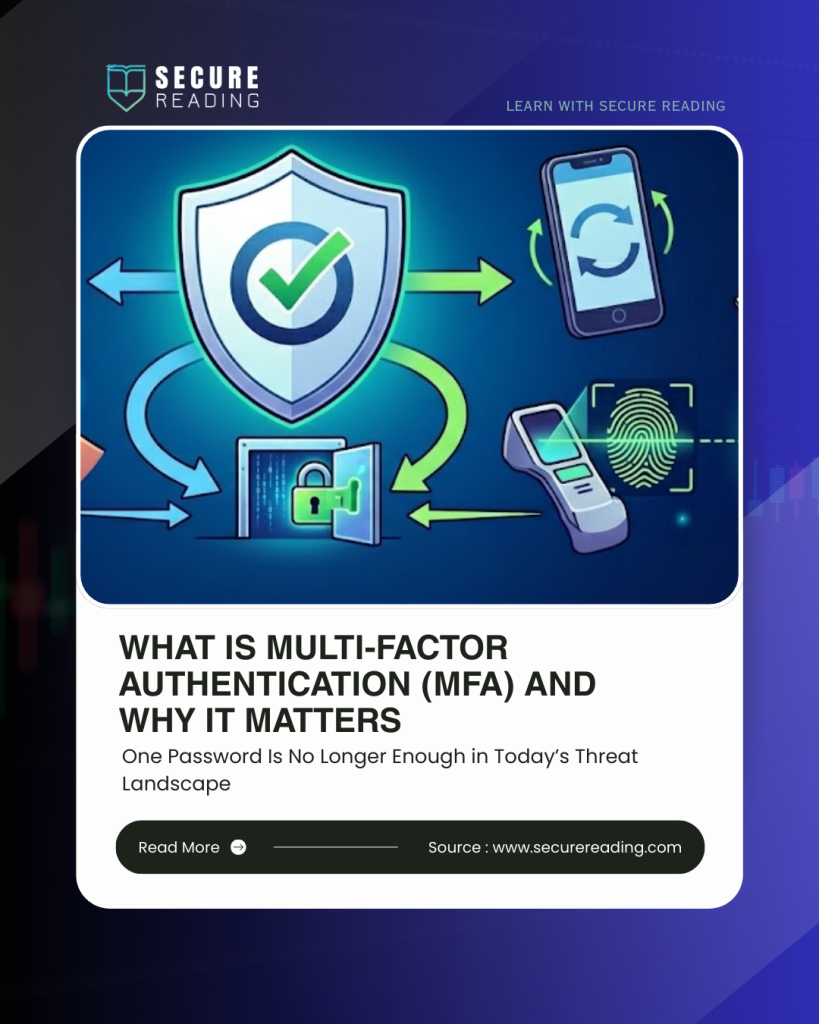
Every day, attackers steal passwords through phishing, data breaches, malware, and social engineering. However, stealing a password should not mean gaining access.
That’s where Multi-Factor Authentication (MFA) becomes critical.
What Is Multi-Factor Authentication?
Multi-Factor Authentication (MFA) is a security method that requires users to verify their identity using two or more different factors before gaining access to an account or system.
Instead of relying only on something you know (like a password), MFA adds extra verification layers.
These factors typically fall into three categories:
1️⃣ Something You Know
- Password
- PIN
- Security question
2️⃣ Something You Have
- One-Time Password (OTP) via SMS
- Authenticator app (Google Authenticator, Microsoft Authenticator)
- Hardware security key (YubiKey)
3️⃣ Something You Are
- Fingerprint
- Face recognition
- Retina scan
When at least two of these are combined, security increases dramatically.
How MFA Works (Simple Example)
- You enter your username and password.
- The system asks for a second verification step.
- You approve a push notification or enter a one-time code.
- Access is granted.
Even if a hacker steals your password, they cannot log in without the second factor.
Why MFA Matters More Than Ever
???? Passwords Get Stolen Every Day
According to multiple breach reports, compromised credentials remain the #1 cause of cyber incidents. Employees reuse passwords. Databases leak. Phishing emails trick users.
MFA reduces this risk significantly.
???? It Blocks the Majority of Account Takeovers
Studies show that enabling MFA can block over 99% of automated credential attacks.
Therefore, MFA is one of the simplest and most effective security controls an organization can deploy.
???? It Protects Financial and Business Systems
MFA helps prevent:
- Business Email Compromise (BEC)
- Payroll fraud
- Banking login abuse
- Cloud account hijacking
- Admin privilege abuse
Without MFA, a single stolen password can expose an entire network.
???? It’s Now a Compliance Requirement
Many regulations require MFA, including:
- ISO/IEC 27001
- NIST guidelines
- PCI DSS 4.0
- SOC 2
- GDPR security best practices
Organizations that ignore MFA may face both financial and legal consequences.
Common Misconceptions About MFA
❌ “SMS OTP is enough”
SMS is better than nothing. However, SIM swapping attacks can bypass it. Authenticator apps or hardware keys are stronger.
❌ “MFA slows down employees”
Modern MFA methods like push approvals or biometrics take seconds.
❌ “We’re too small to be targeted”
Small businesses are often targeted because they lack layered protection.
Types of MFA You Should Know
- OTP Apps (Time-based codes)
- Push Notification Approval
- Hardware Security Keys (FIDO2)
- Biometric Authentication
- Passkeys (Passwordless MFA built on WebAuthn)
The strongest options combine phishing-resistant technology like hardware keys or passkeys.
The Business Impact of Not Using MFA
Without MFA:
- One phishing email can compromise executives
- Cloud data can be stolen silently
- Attackers can deploy ransomware
- Reputation damage becomes irreversible
In contrast, MFA adds a strong barrier at minimal cost.
Final Thought
Multi-Factor Authentication is no longer optional. It is foundational.
In today’s threat environment, relying on passwords alone is like locking your office door but leaving the windows open.
If your organization does not enforce MFA across email, VPN, cloud platforms, and admin accounts — it is operating at unnecessary risk.