

Preparing for the Quantum Era: Why Security Leaders Must Act on Post-Quantum Cryptography Now
Encrypted data transmitted today could become readable in the future. Security leaders must understand the “harvest now, decrypt later” threat and start preparing for quantum-safe security.
The Hidden Risk Behind Today’s Encryption
Most organizations believe that encrypted data remains secure as long as strong encryption is in place. However, a growing concern in the cybersecurity community challenges this assumption.
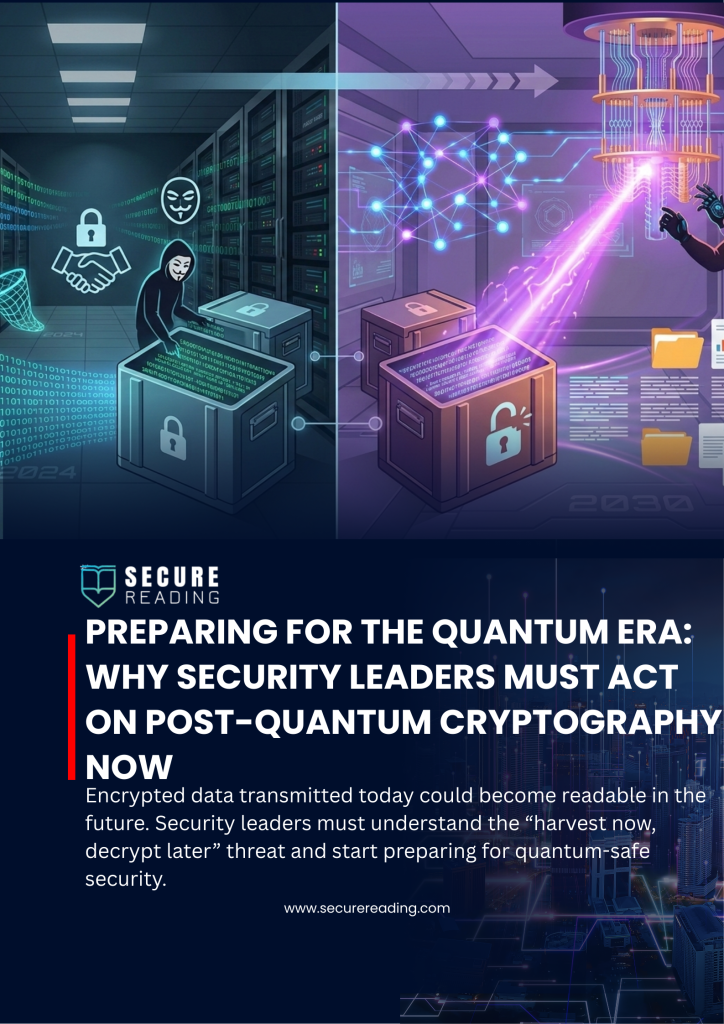
Attackers are increasingly adopting a strategy known as “harvest now, decrypt later.” Instead of trying to break encryption today, they collect encrypted data and store it for the future. Once quantum computing becomes powerful enough, these attackers could decrypt the information and reveal sensitive data that was thought to be protected.
This approach means that information transmitted today—such as intellectual property, financial records, healthcare data, and government communications—may become vulnerable years later.
Therefore, organizations that rely heavily on encryption must start preparing for the coming quantum era.
Why Quantum Computing Changes the Encryption Landscape
Modern cryptography relies on mathematical problems that traditional computers struggle to solve. Algorithms such as RSA and elliptic curve cryptography (ECC) protect everything from online banking to enterprise communications.
However, quantum computers operate differently. They can solve certain mathematical problems far more efficiently than classical machines. As quantum technology advances, it may eventually break widely used encryption algorithms.
For organizations that must protect sensitive data for decades, waiting until quantum computers become fully capable could be too late. Security leaders must begin evaluating quantum-resistant strategies today.
Hybrid Cryptography: A Practical First Step
One practical approach gaining attention is hybrid cryptography. This method combines traditional encryption algorithms with new quantum-resistant algorithms designed to withstand quantum attacks.
For example, hybrid systems may integrate traditional encryption with algorithms such as ML-KEM, a quantum-resistant key encapsulation mechanism. By combining both approaches, organizations can strengthen security without disrupting existing infrastructure.
Additionally, hybrid cryptography allows security teams to test and transition toward quantum-safe systems gradually rather than replacing their entire cryptographic framework at once.
How Organizations Can Start Preparing
Preparing for quantum threats requires a strategic approach. Security teams must first understand where encryption exists across their environments and how critical data flows through those systems.
Organizations that prepare early typically focus on several key steps:
- Identify sensitive data that must remain confidential for many years
- Map where encryption is used across applications, networks, and infrastructure
- Adopt hybrid cryptography strategies to strengthen existing protections
- Maintain visibility into cryptographic algorithms used across systems
Additionally, maintaining visibility into encrypted traffic remains essential. Security teams still need to inspect traffic, enforce policies, and detect threats while encryption continues to evolve.
The Role of Zero Trust in Quantum-Ready Security
Modern Zero Trust architectures also play a critical role in preparing for the quantum era. These architectures ensure that organizations continuously verify users, devices, and connections rather than relying on traditional perimeter security.
With proper inspection of encrypted traffic and strong access controls, security teams can maintain visibility and enforcement even as cryptographic standards evolve.
Therefore, combining Zero Trust principles with quantum-safe cryptography provides a strong foundation for long-term data protection.
Learning How to Transition to Quantum-Safe Security
For many security leaders, the biggest challenge lies in understanding how to begin the transition toward quantum-safe security without disrupting existing systems.
Industry experts are increasingly discussing practical approaches, including hybrid encryption models, post-quantum traffic inspection, and strategies for managing cryptographic transitions across large environments.
Security leaders who understand these changes early will be better positioned to protect sensitive data, maintain compliance, and prepare their organizations for the next generation of cybersecurity challenges.
Quantum computing may still be developing, but its impact on cybersecurity is already shaping today’s security strategies.