

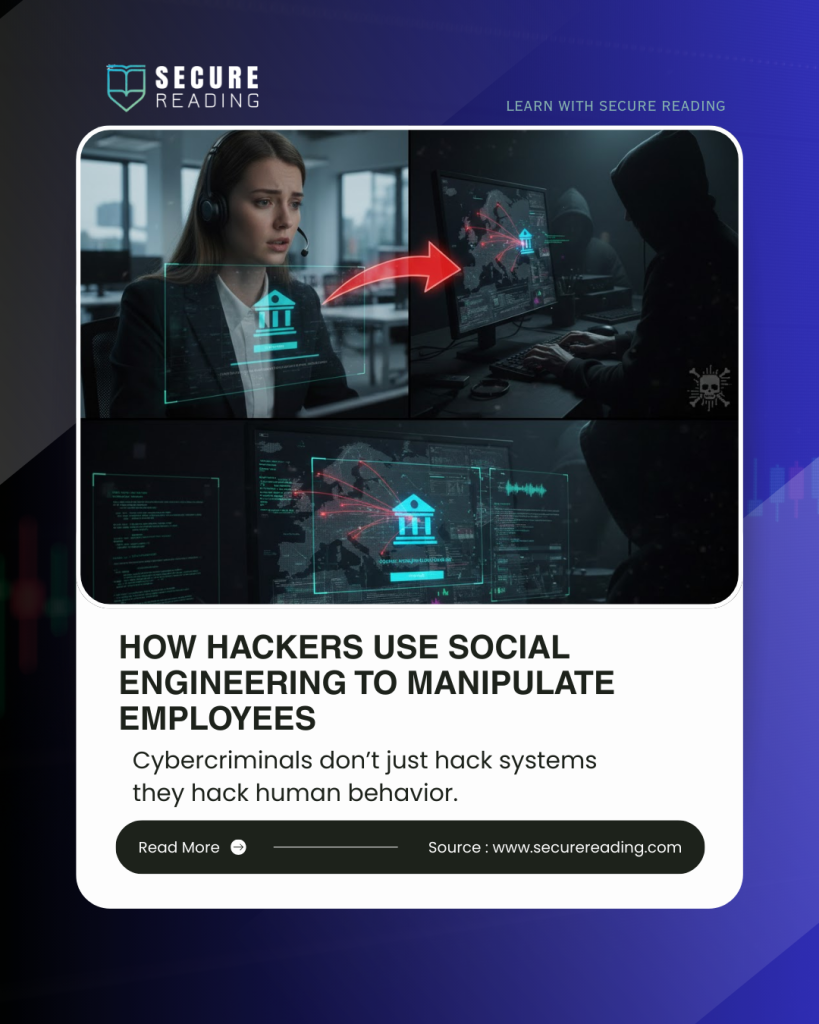
How Hackers Use Social Engineering to Manipulate Employees
Cybercriminals don’t just hack systems — they hack human behavior.
Why Humans Are the Real Target
Most major breaches do not begin with advanced malware. Instead, they start with a simple message, phone call, or fake request.
Attackers understand one critical truth:
It is easier to trick a person than to break strong encryption.
Therefore, they focus on psychology instead of code.
What Is Social Engineering?
Social engineering is the art of manipulating people into revealing confidential information or performing actions that compromise security.
Rather than exploiting software vulnerabilities, attackers exploit:
- Trust
- Authority
- Urgency
- Fear
- Curiosity
As a result, even well-trained employees can become entry points.
Common Social Engineering Techniques
1. Phishing Emails
Attackers send emails that appear to come from trusted sources such as banks, HR departments, or senior executives.
They often include:
- Fake invoices
- Password reset requests
- Urgent financial approvals
Once the employee clicks the link, the attacker steals credentials or installs malware.
2. Business Email Compromise (BEC)
In BEC attacks, criminals impersonate executives or vendors.
For example:
- A fake CEO requests an urgent wire transfer.
- A vendor email changes bank account details.
Because the request appears legitimate, finance teams may process payments without verification.
3. Pretexting
Attackers create a believable scenario to gain trust.
They might pretend to be:
- IT support
- A new employee
- A regulatory auditor
By building credibility, they persuade employees to share sensitive information.
4. Vishing and Smishing
Voice phishing (vishing) uses phone calls.
SMS phishing (smishing) uses text messages.
These methods create urgency, such as:
- “Your account will be locked in 30 minutes.”
- “Confirm this OTP immediately.”
Employees who act quickly often skip verification steps.
5. Physical Social Engineering
Not all attacks happen online.
Attackers may:
- Tailgate into secure buildings
- Leave infected USB drives in offices
- Impersonate maintenance staff
Once inside, they can access networks directly.
Why Employees Fall for These Attacks
Social engineering works because it triggers emotional responses.
Attackers create:
- Urgency to bypass critical thinking
- Fear of consequences
- Pressure from perceived authority
Moreover, busy employees prioritize productivity. As a result, security checks may feel like obstacles rather than protections.
The Real Business Impact
A single successful social engineering attempt can lead to:
- Credential theft
- Ransomware deployment
- Financial fraud
- Data breaches
- Regulatory penalties
In many cases, attackers move laterally inside the network after initial access. Therefore, one click can escalate into a full organizational compromise.
How Organizations Can Defend
Technology alone cannot stop social engineering. However, layered defense significantly reduces risk.
Organizations should:
- Conduct regular security awareness training
- Simulate phishing campaigns
- Enforce multi-factor authentication
- Implement email filtering and DMARC
- Require verification for financial transactions
- Encourage a “verify first” culture
Additionally, leadership must support employees who report suspicious activity. Fear of punishment often prevents early reporting.
Final Thought
Hackers do not need zero-day exploits when they can exploit human trust.
Social engineering attacks will continue evolving. However, organizations that combine technology, training, and culture create a powerful defense.
The question is not whether employees will be targeted.
The question is whether they are prepared to recognize manipulation before it becomes a breach.