
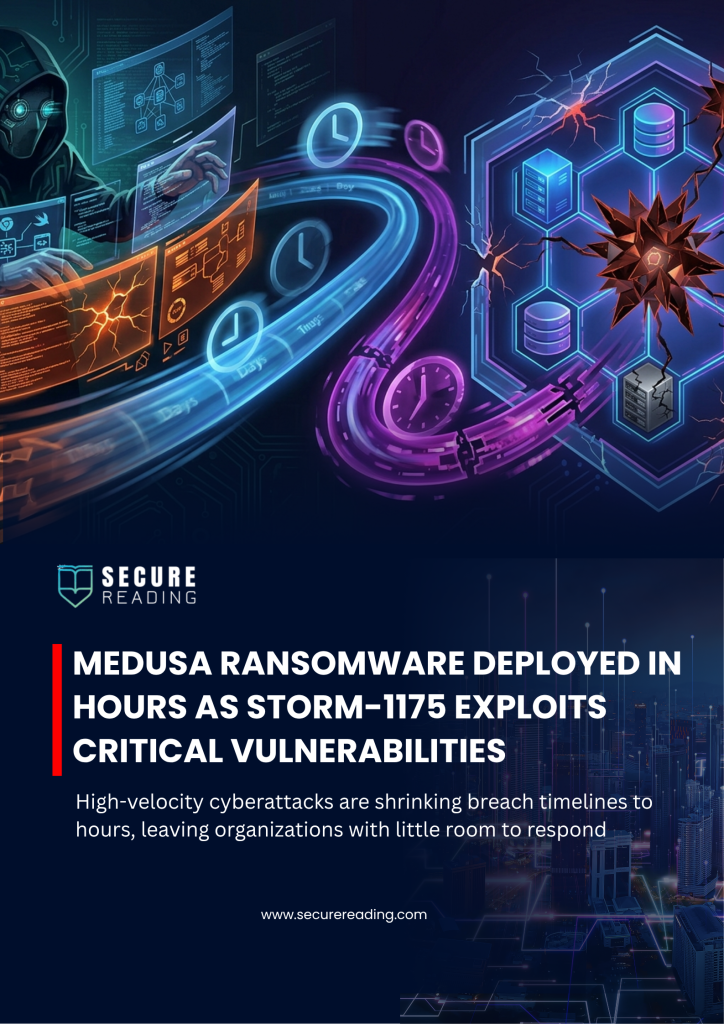
Medusa Ransomware Deployed in Hours as Storm-1175 Exploits Critical Vulnerabilities
High-velocity cyberattacks are shrinking breach timelines to hours, leaving organizations with little room to respond
A China-linked threat actor, tracked as Storm-1175, has significantly escalated ransomware operations by combining zero-day and recently disclosed vulnerabilities to execute rapid, high-impact attacks. Unlike traditional ransomware groups that take weeks to move across networks, this actor operates with extreme speed—often deploying Medusa ransomware within 24 hours of initial access.
This shift signals a dangerous evolution in cyber threat behavior. Attackers are no longer relying solely on known weaknesses; instead, they actively exploit vulnerabilities before patches are available or widely applied, creating a narrow and critical window of exposure.
Storm-1175 has demonstrated a consistent pattern of targeting internet-facing systems, particularly in sectors that cannot afford downtime. Healthcare, education, finance, and professional services organizations across the United States, United Kingdom, and Australia have already experienced significant disruptions. Meanwhile, the broader implications extend globally, including high-risk regions such as the UAE and GCC, where digital transformation continues to expand the attack surface.
The group’s operational strength lies in its ability to chain multiple vulnerabilities together. For example, it combines zero-day exploits with N-day vulnerabilities like those affecting Microsoft Exchange, Ivanti appliances, and remote management tools. As a result, attackers bypass traditional defenses and establish access before security teams can react.
Once inside, Storm-1175 moves with precision. It establishes persistence by creating new user accounts and deploying web shells or remote monitoring and management (RMM) tools. Tools such as AnyDesk, Atera, and ConnectWise ScreenConnect are abused to blend malicious activity with legitimate administrative traffic. Consequently, detection becomes significantly harder.
Additionally, the attackers rely heavily on living-off-the-land techniques. Using tools like PowerShell, PsExec, and Impacket, they move laterally across networks without triggering alarms. They also dump credentials using Mimikatz, disable or bypass security controls, and modify firewall rules to enable Remote Desktop Protocol access.
Data exfiltration plays a critical role in their strategy. By leveraging tools like Rclone and Bandizip, the group extracts sensitive data before launching ransomware. This dual-threat approach—data theft combined with encryption—maximizes pressure on victims to pay.
Another concerning trend is their increasing focus on Linux environments and enterprise infrastructure, including Oracle WebLogic servers. This indicates a broader targeting strategy that goes beyond traditional Windows-based systems, reflecting a more advanced and adaptable threat model.
The key takeaway is clear: Storm-1175 thrives in the gap between vulnerability disclosure and patch implementation. Organizations that delay patching or lack visibility into exposed assets become immediate targets.
What This Means for Businesses
Organizations must rethink their defense strategy. Traditional reactive security models are no longer sufficient. Instead, businesses should:
- Prioritize real-time vulnerability management
- Continuously monitor internet-facing assets
- Restrict and audit the use of RMM tools
- Implement Zero Trust architecture
- Strengthen endpoint detection and response (EDR) capabilities
For CISOs and security leaders, the focus must shift from detection to prevention and rapid response. The speed of modern attacks demands equally fast defensive measures.