
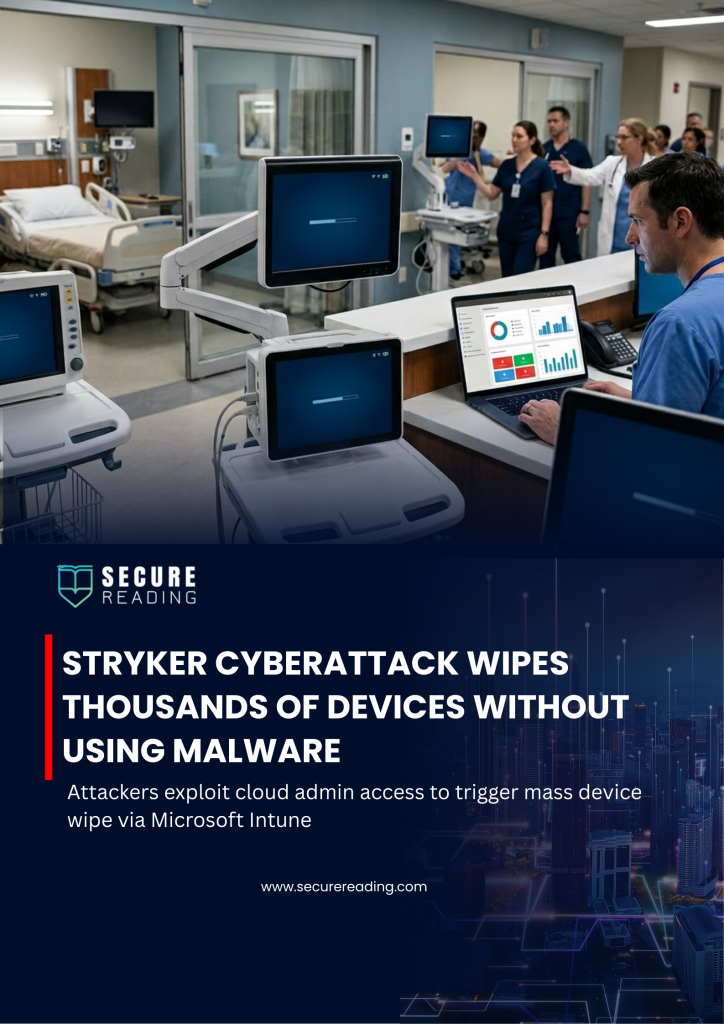
Stryker Cyberattack Wipes Thousands of Devices Without Using Malware
Attackers exploit cloud admin access to trigger mass device wipe via Microsoft Intune
A recent cyberattack on medical technology giant Stryker has revealed a disruptive new attack pattern—one that requires no malware, no ransomware, and no traditional payloads.
Instead, attackers leveraged legitimate administrative tools to remotely wipe tens of thousands of corporate devices, causing widespread operational disruption across the organization.
A Different Kind of Cyberattack
Unlike conventional attacks, this incident did not involve malicious software. Instead, threat actors gained access to Stryker’s internal Microsoft environment and used Microsoft Intune, a cloud-based endpoint management platform, to execute remote wipe commands.
Within a short window of just a few hours, thousands of devices were erased.
This shift highlights a growing trend:
Attackers are increasingly abusing trusted enterprise tools instead of deploying malware.
How the Attack Unfolded
Investigations indicate that the attacker:
- Compromised an administrator account
- Created a new Global Administrator account
- Used elevated privileges to issue mass device wipe commands
Between 5:00 and 8:00 a.m. UTC, nearly 80,000 devices were reportedly wiped using Intune’s built-in functionality.
Meanwhile, some claims suggested over 200,000 devices were affected, although official confirmation remains lower.
No Malware, No Data Theft—Still Devastating
Interestingly, there is currently no evidence of malware deployment or data exfiltration. However, the impact remains severe:
- Employees lost access to corporate systems overnight
- Some personal devices enrolled in corporate management were also wiped
- Core business operations, including ordering systems, were disrupted
As a result, customers had to place orders manually through sales representatives.
Operational Impact and Recovery
Stryker has confirmed that:
- All medical and life-saving devices remain safe and unaffected
- The attack was limited to its internal corporate IT environment
- Recovery efforts are actively underway
The company is prioritizing:
- Restoration of transactional systems
- Resumption of shipping and supply chain operations
- Stabilization of internal IT infrastructure
Additionally, global cybersecurity teams, including incident response experts, are assisting in the investigation.
Key Cybersecurity Lessons for Organizations
This incident sends a strong message to CISOs and security leaders:
1. Identity Is the New Perimeter
Attackers didn’t break systems—they logged in.
Therefore, protecting privileged accounts is more critical than ever.
2. Legitimate Tools Can Become Weapons
Tools like Intune are designed for efficiency. However, in the wrong hands, they become highly destructive.
3. Cloud Security Misconfigurations Amplify Risk
Centralized cloud management platforms can scale both productivity—and damage.
4. Insider-Level Access Equals Maximum Impact
Once attackers gain admin-level control, traditional defenses often fail to stop them.
What Organizations Should Do Now
To reduce similar risks, organizations should:
- Enforce Multi-Factor Authentication (MFA) on all privileged accounts
- Implement Privileged Access Management (PAM) solutions
- Monitor for unusual admin activities, especially account creation
- Restrict and audit remote device management actions
- Apply Zero Trust principles across cloud environments
Final Insight
This attack proves a critical shift in modern cyber threats:
You don’t need malware to cause damage—access is enough.
Organizations must move beyond traditional threat detection and focus on identity security, access control, and behavioral monitoring to defend against this evolving threat landscape.