

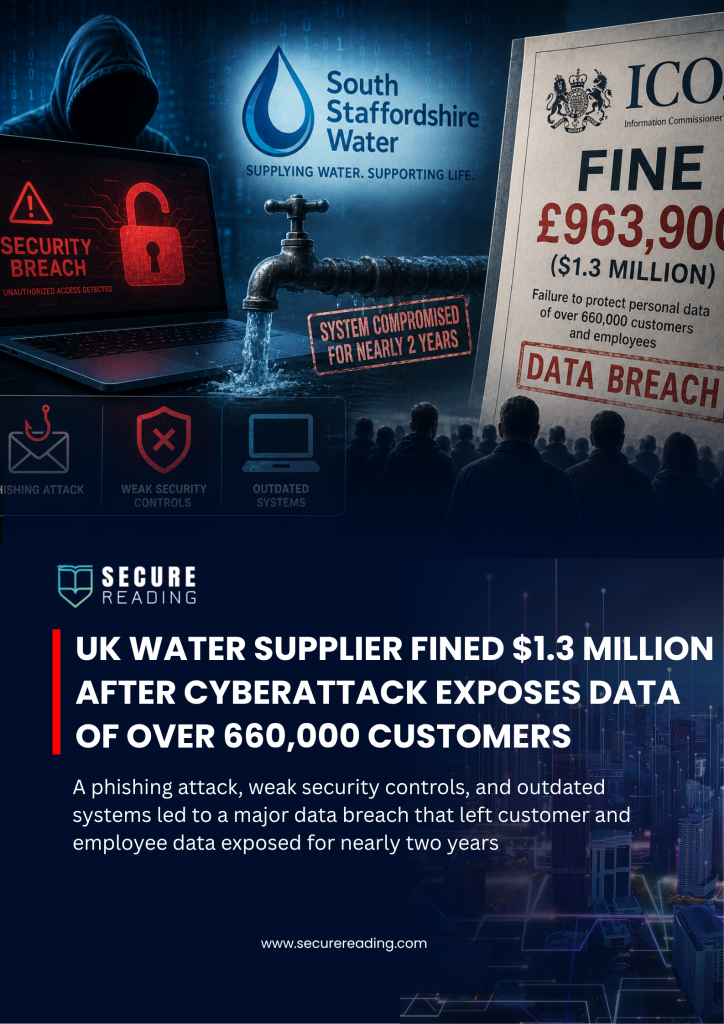
UK Water Supplier Fined $1.3 Million After Cyberattack Exposes Data of Over 660,000 Customers
A phishing attack, weak security controls, and outdated systems led to a major data breach that left customer and employee data exposed for nearly two years.
Cyberattack Leads to Major Regulatory Fine
The UK Information Commissioner’s Office (ICO) has fined South Staffordshire Water Plc and its parent company South Staffordshire Plc £963,900 after a cyberattack exposed the personal data of more than 660,000 customers and employees.
The company supplies drinking water to around 1.6 million consumers every day. However, a serious security failure allowed attackers to remain inside its systems for nearly two years before the breach was discovered.
This case highlights how delayed detection and weak internal controls can turn a single phishing attack into a large-scale data exposure incident.
How the Attack Started
According to the ICO, the breach began with a phishing attack in September 2020. Attackers used that entry point to install malware inside the company’s network.
The malware stayed hidden for around 20 months without detection.
Between May and July 2022, the attackers escalated privileges across the environment and eventually gained domain administrator access. This gave them deeper control over critical systems and sensitive data.
The company only discovered the incident in July 2022 after IT performance issues triggered an internal investigation.
What Data Was Exposed
The attackers extracted and published sensitive information belonging to 663,887 individuals.
The leaked data included full names, home addresses, email addresses, phone numbers, dates of birth, customer account credentials, and bank account details.
Employee HR records were also exposed, including National Insurance numbers and other confidential personal information.
This level of exposure created serious risks for identity theft, financial fraud, and targeted phishing attacks.
Key Security Failures Identified
The ICO found several major weaknesses in the company’s cybersecurity practices.
These included poor controls to stop privilege escalation, limited monitoring that covered only about 5% of the IT environment, and the continued use of outdated systems such as Windows Server 2003.
The investigation also found weak vulnerability management, missing security patches, and a lack of regular internal and external security scans.
These failures showed a clear breakdown in basic cyber hygiene and directly contributed to the scale of the breach.
Why the Fine Was Issued
The ICO stated that these security gaps violated UK data protection requirements and left both customers and employees exposed for an unacceptable period.
Because of these failures, regulators imposed a financial penalty of £963,900.
The original fine was higher. However, the company received a 40% reduction because it admitted liability early, cooperated with investigators, and agreed to settle without appeal.
Lessons for Business Leaders
This incident sends a strong message to CISOs, CEOs, and board members across all industries.
Cybersecurity is not only an IT responsibility. It is a governance issue that directly affects regulatory risk, customer trust, and business continuity.
Phishing attacks remain one of the most common entry points for ransomware groups and data theft operations. Without proper monitoring, patch management, and privilege controls, attackers can stay hidden for months.
For organizations in critical infrastructure sectors such as water, energy, and healthcare, the stakes are even higher.
Strong detection capabilities, continuous security reviews, and executive-level accountability are no longer optional. They are essential for protecting both operations and reputation.