

Vercel Breach Exposes Credentials After AI Tool Compromise
Third-Party AI Weakness Triggers Supply Chain Security Incident
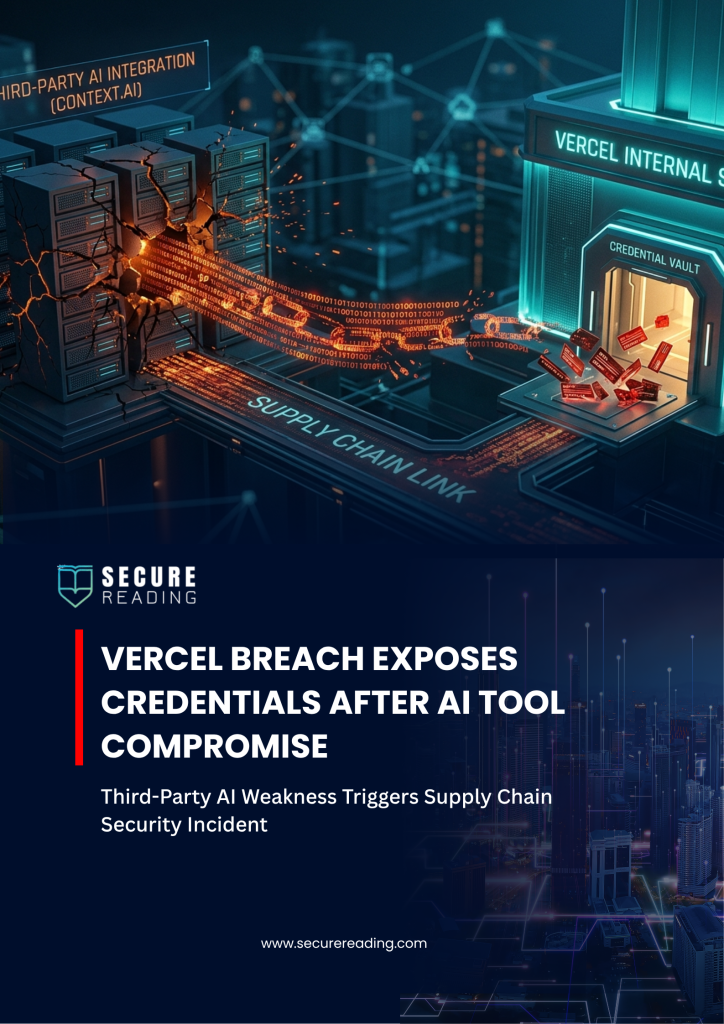
A recent security breach at Vercel has once again highlighted the growing risks tied to third-party tools and AI integrations. The incident, which originated from the compromise of Context.ai, allowed attackers to gain unauthorized access to internal Vercel systems and a limited set of customer credentials.
Although the exposure appears contained, the attack reveals a deeper issue: modern supply chains are now prime entry points for sophisticated threat actors.
How the Breach Happened
The attack began when a Context.ai employee’s system was compromised. Investigations suggest the infection may be linked to Lumma Stealer, a known credential-harvesting malware often distributed through malicious downloads.
Once inside, the attacker extracted corporate credentials, including:
- Google Workspace access
- Internal service logins
- API keys and authentication tokens
Using this data, the attacker successfully took control of a Vercel employee’s Google Workspace account. This access became the gateway into Vercel’s internal environments.
What the Attacker Accessed
After gaining entry, the threat actor accessed:
- Certain internal Vercel systems
- Environment variables not marked as “sensitive”
Importantly, Vercel confirmed that:
- Sensitive environment variables remained encrypted
- There is no evidence these protected secrets were accessed
However, a limited subset of customer credentials was exposed. Affected users have already been notified and instructed to rotate their credentials immediately.
A Sophisticated Threat Actor
Vercel described the attacker as highly capable, citing their speed and deep understanding of internal systems. Meanwhile, the notorious hacking group ShinyHunters has claimed responsibility and is reportedly attempting to sell the stolen data for $2 million.
Further investigation revealed a concerning detail: compromised accounts included high-privilege access such as a support email account. This likely enabled the attacker to escalate privileges and move laterally within the infrastructure.
The Role of Human Behavior
Interestingly, forensic insights suggest the initial compromise may have been avoidable. Reports indicate the infected user downloaded unofficial game-related tools, a common distribution method for infostealers like Lumma.
This reinforces a critical cybersecurity reality:
even advanced organizations remain vulnerable to basic endpoint risks.
Response and Mitigation Efforts
Vercel has taken several immediate steps:
- Partnered with Mandiant for incident response
- Notified law enforcement and affected customers
- Strengthened monitoring and internal controls
- Introduced improved environment variable management tools
Additionally, the company advised organizations to:
- Audit and rotate all credentials and environment variables
- Review activity logs for anomalies
- Investigate recent deployments for unauthorized changes
- Strengthen deployment protection settings
The Bigger Picture: Supply Chain Risk in the AI Era
This incident underscores a growing challenge for CISOs and security teams—AI tools and third-party integrations are expanding the attack surface faster than traditional defenses can adapt.
While organizations often secure their core infrastructure, attackers now target:
- External vendors
- SaaS platforms
- Developer tools
- Identity systems
As a result, a single compromised account can trigger a chain reaction across multiple environments.
For businesses in the UAE and globally, this serves as a critical reminder:
security is no longer confined to your organization—it extends across your entire digital ecosystem.