

What Is a SOC and How Does It Protect Organizations
Behind every strong cybersecurity posture sits a team watching, detecting, and responding before damage spreads.
The Meaning of a Security Operations Center
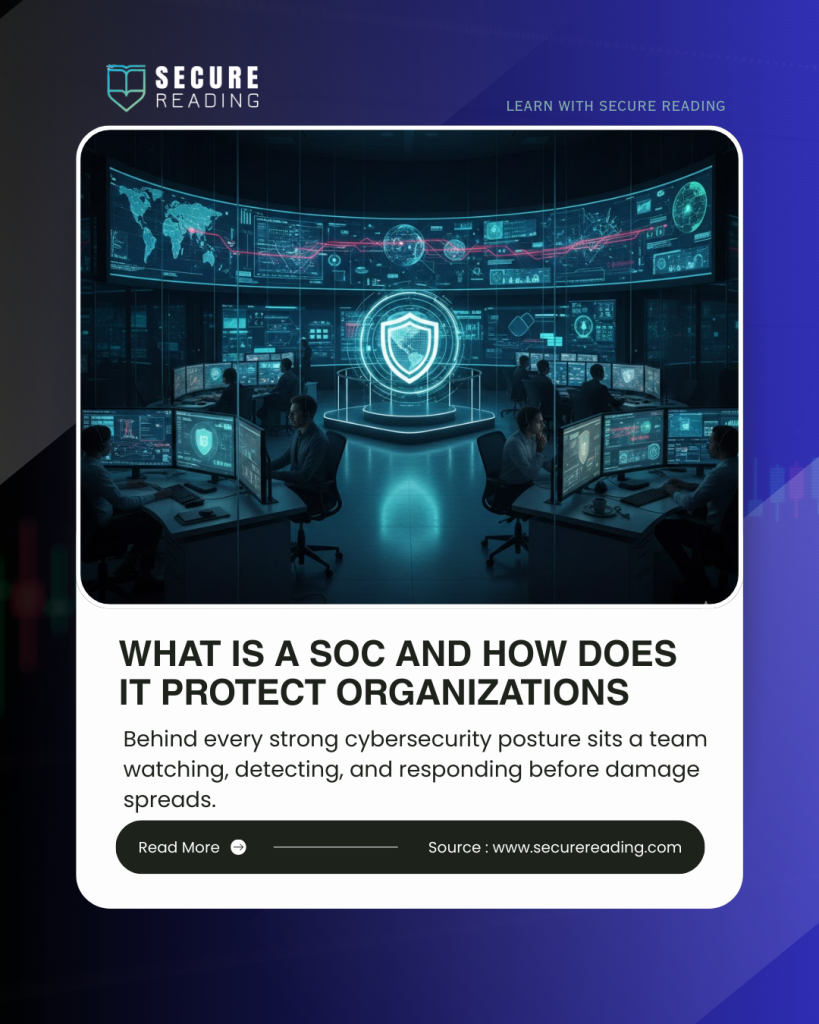
A Security Operations Center (SOC) acts as the central nerve center for cybersecurity operations. It brings together people, processes, and technology to monitor threats, detect attacks, and respond to incidents in real time.
Unlike traditional IT teams that focus on availability and performance, a SOC focuses entirely on security visibility and response. Its goal stays simple but critical: stop threats before they disrupt the business.
Why Organizations Need a SOC Today
Cyberattacks no longer happen occasionally. They operate continuously, often without obvious signs. Meanwhile, attackers automate reconnaissance, phishing, and exploitation.
A SOC protects organizations by:
- Monitoring systems 24/7
- Detecting suspicious behavior early
- Reducing attacker dwell time
- Coordinating rapid incident response
Without a SOC, many attacks remain undetected for weeks or months. By then, damage becomes expensive and public.
How a SOC Actually Works
A SOC continuously collects data from across the organization. This includes endpoints, servers, firewalls, cloud platforms, identity systems, and applications.
Security analysts then:
- Analyze alerts and logs
- Correlate events across systems
- Investigate anomalies
- Contain threats before escalation
When an incident occurs, the SOC leads response actions. These may include isolating infected systems, blocking malicious traffic, resetting credentials, and preserving evidence.
Key Roles Inside a SOC
A SOC operates as a team, not a single analyst.
Common roles include:
- SOC Analysts who investigate alerts and incidents
- Threat Hunters who proactively search for hidden attackers
- Incident Responders who contain and remediate attacks
- SOC Managers who oversee operations and reporting
Each role focuses on speed, accuracy, and coordination. Together, they reduce risk across the organization.
Tools That Power a SOC
Technology enables scale and visibility. However, tools never replace human judgment.
Most SOCs rely on:
- SIEM platforms for log collection and correlation
- EDR tools for endpoint visibility and response
- Network detection systems for traffic analysis
- Threat intelligence feeds for known attacker indicators
When integrated properly, these tools provide context instead of noise.
SOC Value Beyond Security Teams
A mature SOC does more than stop malware. It protects business continuity, brand trust, and regulatory compliance.
For leadership teams, a SOC:
- Reduces financial and operational risk
- Supports incident reporting obligations
- Provides measurable security metrics
- Enables informed decision-making during crises
As a result, SOCs now play a strategic role, not just a technical one.
SOC Models Organizations Can Choose
Organizations adopt SOCs in different ways based on size and risk appetite.
Common models include:
- In-house SOC for full control and customization
- Managed SOC (MSSP) for cost efficiency and rapid maturity
- Hybrid SOC combining internal oversight with external expertise
Each model works when governance, visibility, and accountability remain clear.
The Bottom Line
A SOC transforms cybersecurity from a reactive function into a continuous defense capability. It shortens response time, limits damage, and keeps attackers from operating freely.
In today’s threat landscape, organizations without a SOC do not lack tools. They lack visibility and coordinated response—and attackers exploit that gap fast.