
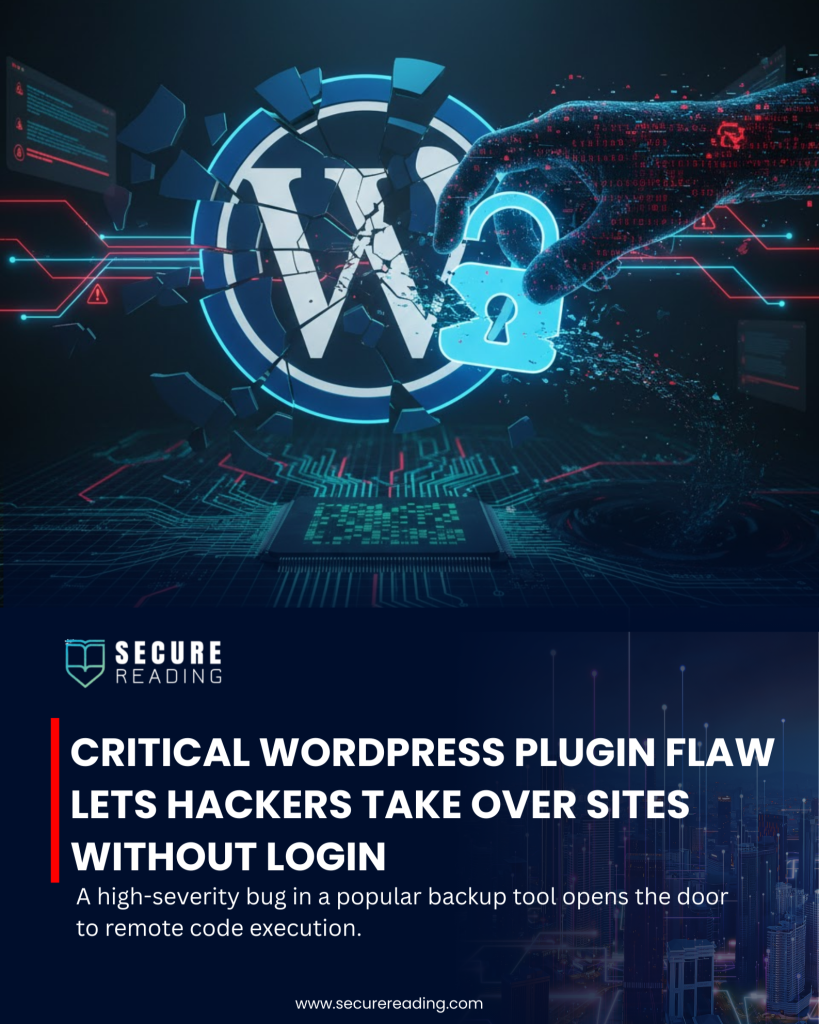
Critical WordPress Plugin Flaw Lets Hackers Take Over Sites Without Login
A high-severity bug in a popular backup tool opens the door to remote code execution.
Vulnerability Overview
A critical weakness in the WPvivid Backup & Migration plugin could allow attackers to upload arbitrary files and execute code without authentication. The issue carries the identifier CVE-2026-1357 and received a severity score of 9.8.
More than 900,000 WordPress websites run the plugin. Successful exploitation could lead to a full site takeover.
Who Is Truly at Risk
Researchers at Defiant clarified that the most severe impact appears when administrators enable the “receive backup from another site” option.
This setting is not active by default. However, many teams temporarily switch it on during migrations or hosting changes. That operational reality increases the likelihood of exposure.
Attackers also face a timing constraint. They must use a generated transfer key within a 24-hour window.
How the Exploit Works
Security researcher Lucas Montes (NiRoX) reported the flaw in January.
The vulnerability combines two major weaknesses.
First, the plugin mishandled cryptographic errors. When RSA decryption failed, execution continued. The system then treated the failed output as predictable data, which attackers could abuse to craft accepted payloads.
Second, the upload process lacked proper filename sanitization. This gap enabled directory traversal, allowing malicious files to land outside the intended path. Attackers could then place rogue PHP scripts and trigger remote execution.
Patch Released
After validating the proof of concept, Defiant notified the vendor, WPVividPlugins.
The company released version 0.9.124 within days. The update:
- Stops execution when decryption fails
- Sanitizes filenames
- Restricts uploads to approved backup formats such as ZIP, GZ, TAR, and SQL
Why This Matters Beyond One Plugin
Backup and migration tools usually operate with elevated privileges. Therefore, weaknesses in these components often provide attackers with direct administrative reach.
Even temporary configuration changes can open high-risk windows. Many compromises occur during these short operational periods.
What Administrators Should Do Now
Website owners should update immediately to the patched version. Additionally, they should review logs for unexpected uploads or unfamiliar files in web directories.
If the feature was enabled recently, assume attackers may have scanned for it.
Bigger Takeaway
Modern attackers move fast. They monitor disclosures, build automation, and hunt for unpatched systems within hours.
Strong patch governance and visibility into temporary exposure windows now matter as much as perimeter defenses.